If you have ever looked at an eBike or eScooter listing and thought, “That range sounds great, but will I actually get that in real life?” you are asking the right question.
Range is one of the most important specs in electric mobility, but it is also one of the easiest to misunderstand. A product page may promise 40, 50, or even 70 miles of range, yet many riders end up seeing much less once they start dealing with hills, stops, colder weather, higher speeds, and normal daily commuting.
That does not always mean the brand is being dishonest. In many cases, it means the advertised number was measured in near-ideal conditions that do not match how most people ride. A lighter rider on flat ground, moving at a steady low speed in warm weather, can get a very different result than a commuter riding in traffic, carrying a bag, and using more assist or throttle.
This is why buyers should not treat the advertised range as a daily-use promise. They should treat it as a best-case scenario, then do a little basic math to estimate what is more realistic.
This article contains affiliate links. If you purchase through these links, Electric Ride Nerd may earn a commission at no additional cost to you. We only recommend gear we trust and have carefully researched.
The good news is that you do not need to be an engineer to figure this out. Once you understand battery watt-hours and the basic factors that affect energy use, you can estimate real eBike or eScooter range much more confidently before you buy.
Why Advertised Range Often Misleads Buyers
Most range claims are built around controlled conditions. That is not unusual in the electric mobility world, but it can create problems for shoppers who assume those numbers reflect normal commuting.
A scooter tested at a low steady speed on flat pavement may go much farther than the same scooter ridden at a faster pace through city traffic. The same is true for eBikes. A brand may advertise a very high mileage figure, but that number may assume Eco mode, light pedaling pressure, warm temperatures, and little wind.
In other words, the advertised number is often based on a best-case scenario—not the way most people actually ride day to day.
Why Real Range Looks Different in Daily Riding
This side-by-side comparison makes it easier to see why real-world range often falls short of the headline number.

How to Calculate Battery Watt-Hours for an eBike or eScooter
The most useful number for estimating real range is battery capacity in watt-hours, often written as Wh.
Watt-hours tell you how much total energy the battery stores. Once you know that number, you can estimate how quickly that energy will be used based on your riding style and conditions.
The formula is simple:
Battery watt-hours = volts × amp-hours
So if a bike or scooter has a 48V 15Ah battery, the math looks like this:
48 × 15 = 720Wh
That means the battery stores about 720 watt-hours of energy.
Here are a few more common examples:
- 36V 10Ah = 360Wh
- 48V 12.5Ah = 600Wh
- 48V 15Ah = 720Wh
- 48V 20Ah = 960Wh
- 52V 20Ah = 1,040Wh
This number is much more useful than a marketing range claim on its own because it gives you a consistent way to compare one model to another.
How to Estimate Real Range From Battery Size
Once you know the battery watt-hours, the next step is to estimate how much energy the vehicle will use per mile.
That gives you this formula:
Estimated range = battery watt-hours ÷ watt-hours used per mile
This is where real-world range starts to come into focus.
For eScooters, many normal riders land somewhere around 18 to 30Wh per mile depending on speed, terrain, rider weight, and riding style.
For eBikes, the range is wider because pedal assist changes everything. Riders who pedal consistently in low assist can be very efficient, while heavier fat-tire bikes ridden hard on throttle can use power much faster. A practical working range is often around 15 to 35Wh per mile. If you already know you are shopping in that heavier, higher-output category, this is exactly why battery size and real-world utility matter more than headline claims.
That means a 720Wh battery can produce very different results depending on how it is used.
- At 18Wh per mile, 720Wh could deliver about 40 miles
- At 25Wh per mile, it drops to about 29 miles
- At 30Wh per mile, it falls closer to 24 miles
That is why two products with similar battery sizes can feel very different in daily use.
A Simple Way to Visualize Real Range
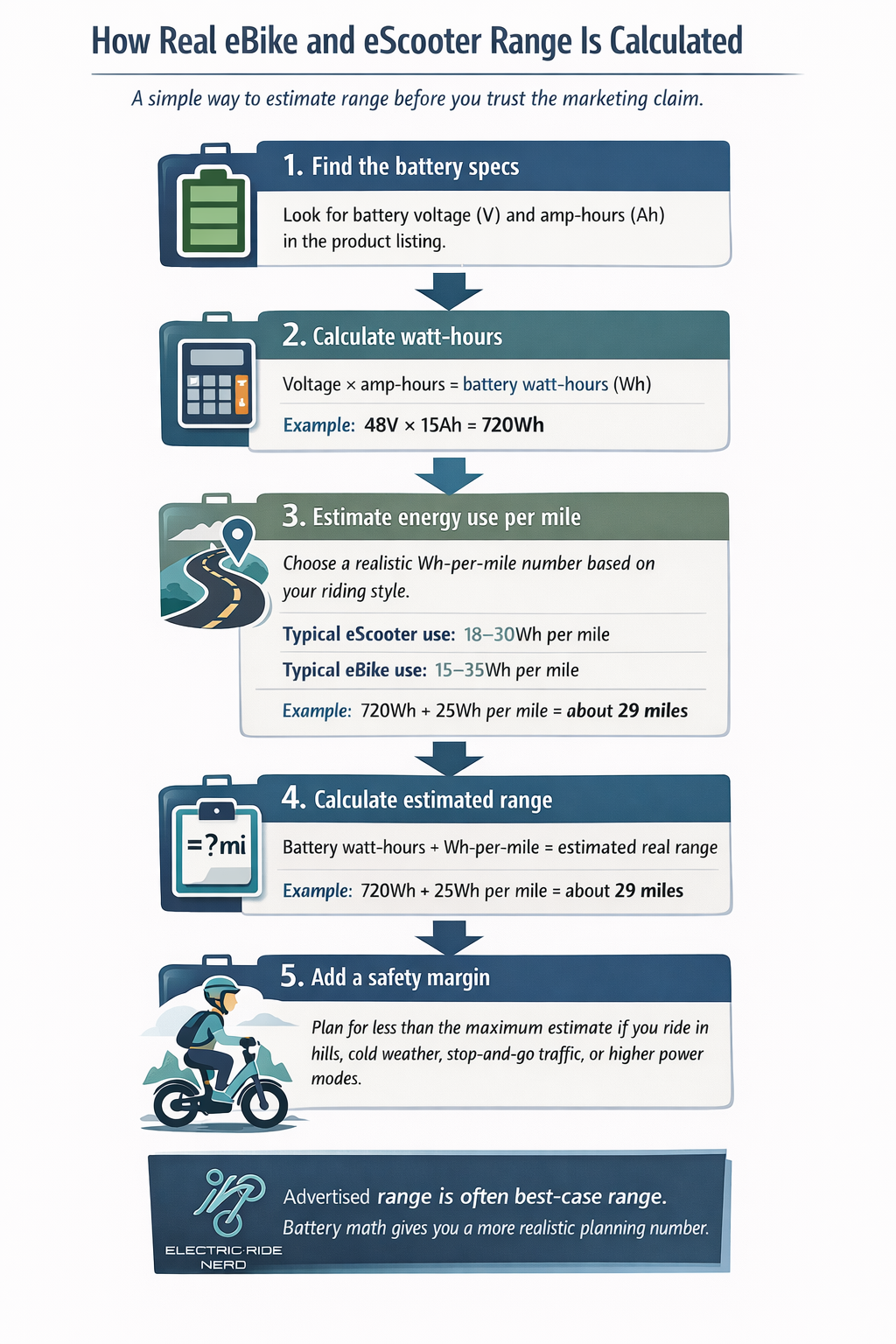
If you prefer to see the process step-by-step, this quick visual breaks down how battery size turns into a realistic range estimate.
Try the Range Estimator Before You Trust the Headline Claim
Not sure whether a listing’s range claim is realistic? Enter the battery specs here first.
Range Estimator Tool
Use this simple calculator to estimate more realistic eBike or eScooter range based on battery size and riding style.
This tool gives a planning estimate, not a guaranteed result. Hills, rider weight, wind, temperature, tire pressure, and throttle use can all reduce actual range.
Use the voltage and amp-hour numbers from the product listing, then choose the riding style that sounds closest to your real use. The estimate does not need to be perfect to be useful. Its job is to give you a more grounded planning number than the headline claim alone.
A good short setup line above the tool would be:
Quick Reference Table: Estimated Real Range by Battery Size
For readers who want a fast reference before they do the math, a table like this can help translate battery size into a more practical range window.
| Battery Size (Wh) | Efficient Use | Mixed Use | Aggressive Use |
|---|---|---|---|
| 360Wh | 18–24 miles | 12–18 miles | 10–12 miles |
| 500Wh | 25–33 miles | 17–25 miles | 14–17 miles |
| 600Wh | 30–40 miles | 20–30 miles | 16–20 miles |
| 720Wh | 36–48 miles | 24–36 miles | 20–24 miles |
| 960Wh | 48–64 miles | 32–48 miles | 27–32 miles |
| 1,040Wh | 52–69 miles | 35–52 miles | 29–35 miles |
This table is not meant to replace the calculator. It is there to help readers quickly understand the scale of the battery they are looking at.
In general, “Efficient Use” means flatter routes, moderate speed, and lighter power demand. “Mixed Use” is a more normal commuting scenario. “Aggressive use” assumes more hills, more speed, more stops, heavier riders, or more throttle-heavy riding.
What Affects Real eBike and eScooter Range?
Battery size matters, but real range is shaped by several riding conditions that can change the result more than many buyers expect.
Speed
Speed is one of the biggest reasons riders fall short of the advertised number. Once you start riding faster, energy use increases quickly, especially on scooters. A model that can technically hit its claimed range at a gentle pace may lose a large amount of range when ridden closer to its top speed.
Rider Weight and Cargo
Heavier riders require more energy to get moving and to maintain momentum, especially on hills. Add a backpack, groceries, work gear, or child cargo to the equation and the demand rises again.
Hills and Stop-and-Go Traffic
Long climbs use more battery than flat terrain, and repeated starts in city traffic also drain energy faster. This is one reason why a suburban greenway ride and a downtown commute can produce very different real-world results from the same machine.
Temperature
Temperature
Cold weather reduces battery performance. Riders in northern U.S. states and Canada often notice that their winter range drops compared to warmer months. That does not mean the battery is defective. It means the conditions are harder on the system. The EPA also notes that electric vehicle range can vary with temperature and real driving conditions, which is one reason riders often see a meaningful difference once the weather turns colder. You can see that explained in the EPA’s page on electric and plug-in hybrid electric vehicles.
Tire Pressure, Surface, and Terrain
Low tire pressure increases rolling resistance. Rough pavement, gravel, wet roads, and off-road paths all require more power than smooth pavement. Fat tires also tend to trade some efficiency for comfort, traction, and stability.
Assist Level or Throttle Use
On eBikes, the amount of rider input matters a lot. A rider using low assist and pedaling steadily can stretch a battery much farther than someone using high assist or throttle for most of the trip.
How to Think About Wh per Mile in Real Riding
A big part of getting a realistic estimate is choosing the right energy-use assumption.
For eScooters, a simple middle-ground estimate is often 25Wh per mile. That is why many practical calculations start there.
So if a scooter has a 600Wh battery:
600 ÷ 25 = 24 miles
That is often much closer to real mixed use than an idealized marketing claim.
For eBikes, it helps to think in riding style:
- 15 to 20Wh per mile: light assist, steady pedaling, flatter routes
- 20 to 25Wh per mile: mixed use, moderate assist, some hills
- 25 to 35Wh per mile: throttle-heavy use, heavier bikes, fat tires, cargo, or steep hills
So if an eBike has a 960Wh battery:
- At 18Wh per mile, it could go about 53 miles
- At 25Wh per mile, it could go about 38 miles
- At 32Wh per mile, it could go about 30 miles
That wide spread is exactly why range claims need context.
How Much Range Do You Really Need for Daily Commuting?
This is where the article should shift from explanation to buying guidance.
A lot of shoppers make the mistake of buying for the exact trip they need under perfect conditions. That usually leaves too little margin once weather, hills, battery aging, detours, or harder riding days enter the picture.
A better approach is to buy for your real-world routine plus extra headroom.
If your round-trip commute is about 10 miles, most decent commuter scooters and eBikes should handle that without much trouble. But even then, it is smarter to buy something that can realistically deliver more than that, not just barely match it.
If your round-trip commute is about 20 miles, range starts to matter more. A model with a small battery may still look fine on paper, but once cold weather or hills show up, the margin gets thin.
If your round-trip commute is 25 miles or more, the buyer should usually look for a noticeably larger battery and think more carefully about how often they will ride at higher speed or on tougher terrain. In some cases, that also means stepping back and asking whether a more aggressive machine actually fits your daily use. If you are weighing everyday practicality against extra power, our guide on commuter vs performance e-mobility can help you think through that tradeoff.
A practical rule is to buy a vehicle that can deliver 30 to 50 percent more real range than your normal trip requires.
So if your normal daily use is 20 miles, a more comfortable planning target is a machine that can realistically do 26 to 30 miles or more.
That extra margin matters for three reasons. First, batteries lose some performance in cold weather. Second, older batteries rarely feel as strong as brand-new ones. Third, many people ride harder than they think they will once they get comfortable with the vehicle. If you want a better sense of how long-term use and upkeep affect real-world ownership, see our guide to eBike and eScooter maintenance for beginners.
How to Tell if an Advertised Range Claim Is Realistic
There is a better way to look at range claims than simply trusting or rejecting them.
Instead of asking, “Is this number real?” ask, “Under what conditions could this number be real?”
Was the range likely tested in Eco mode? Was the rider likely lighter than average? Was the route flat? Was the speed lower than most commuters would use? Was the weather mild?
If the answer to most of those is yes, then the brand’s claim may be technically possible without being representative of daily use.
A quick practical check is to compare your own estimate against the advertised number. In many cases, buyers will find that a realistic planning range comes in well below the posted maximum. Even official EV range testing accounts for real-world factors like cold temperatures, high speed, and aggressive driving that are not fully reflected in laboratory conditions, as the EPA explains in its overview of fuel economy and EV range testing.
That does not make the official number fake. It just means it may describe a best-case result rather than an average commute.
That does not make the official number fake. It just means it may describe a best-case result rather than an average commute.
Why Motor Wattage Does Not Automatically Tell You Range
This is another area where buyers often get tripped up.
A lower-watt motor does not automatically mean better range, and a higher-watt motor does not automatically mean worse range. Motor wattage tells you more about power potential than total endurance.
A vehicle with a larger battery and a strong motor may outlast a lower-powered model with a smaller battery. What matters most is how much energy the battery stores and how hard the vehicle uses that energy in your conditions.
In short, the battery tells you how much fuel is in the tank. The riding conditions and power demand tell you how quickly it will be used.
Real-World Example: eScooter Range Estimate
Imagine you are looking at an eScooter with a 48V 12.5Ah battery.
First calculate watt-hours:
48 × 12.5 = 600Wh
Now estimate mixed-use consumption:
600 ÷ 25 = 24 miles
If the listing claims 37 miles, that is not automatically impossible. But for a normal city rider dealing with real speeds and stop-and-go traffic, 22 to 26 miles may be the more useful planning number.
Real-World Example: eBike Range Estimate
Now imagine an eBike with a 52V 20Ah battery.
Calculate watt-hours:
52 × 20 = 1,040Wh
If the rider pedals regularly in lower assist:
1,040 ÷ 20 = 52 miles
If the rider uses higher assist, throttle, or hilly routes:
1,040 ÷ 30 = about 35 miles
That is a large enough difference to completely change how the bike feels as a commuter purchase.
Red Flags That Should Make Buyers Slow Down
Some listings make it harder than it should be to judge range honestly. That does not always mean the product is bad, but it should make the buyer more careful.
Be cautious when a listing makes a big range promise but does not clearly show battery voltage and amp-hours. Be cautious when the claim seems unusually high for the battery size. Be cautious when a fast, heavy, or dual-motor model claims very long range from what looks like a modest battery.
In many cases, the battery math reveals more than the marketing copy.
A Simple Buyer Checklist Before You Purchase
Before buying an eBike or eScooter, walk through these five steps:
- Find the battery voltage and amp-hours
- Calculate battery watt-hours
- Estimate realistic watt-hours per mile for your riding style
- Divide battery watt-hours by that estimate
- Add extra margin for weather, hills, and battery aging
That short process will usually give you a much more useful buying number than the advertised range alone.
Frequently Asked Questions: Real-World Range Calculation
How do you calculate real eBike or eScooter range?
The most accurate method is to first calculate your total battery capacity: Volts (V) × Amp-hours (Ah) = Watt-hours (Wh). Once you have the Wh, divide that by a realistic "energy burn" estimate (usually 20-30Wh per mile for scooters or 15-25Wh for assisted eBikes) based on your specific terrain and speed.
How far will a 48V 15Ah eBike or eScooter go?
A 48V 15Ah battery provides a total capacity of 720Wh. In real-world commuting conditions with moderate hills and stops, this typically translates to roughly 24 to 40 miles of range. High-speed riding or steep inclines will push you toward the lower end of that estimate.
Is advertised range accurate on electric scooters?
Manufacturer range is often tested under favorable conditions, such as lower speeds, flatter pavement, milder weather, and lighter riders. Because real commuting usually includes higher speeds, stops, hills, and changing conditions, many riders should expect less than the maximum advertised figure in daily use.
How much range do you lose in cold weather?
Cold weather can noticeably reduce battery performance and total range. The exact drop varies by battery, temperature, riding speed, and terrain, but many riders notice a meaningful difference once temperatures get much colder.
Why does rider weight affect electric range?
Physics dictates that more mass requires more energy to accelerate and lift against gravity. Heavier riders or those carrying heavy backpacks will see an increase in Watt-hour consumption per mile, particularly during stop-and-go city riding or when climbing hills.
Should you buy more range than you think you need?
Usually yes. It is smart to buy more real-world range than your normal trip requires. For many riders, planning for roughly 30 to 50 percent more range gives a more comfortable buffer for cold weather, battery aging, hills, detours, and harder riding days.
Final Verdict
If you want to calculate real eBike or eScooter range before you buy, start with the battery and work backward from your actual riding conditions. That is the simplest way to avoid disappointment.
Battery watt-hours tell you how much energy the machine stores. Watt-hours per mile tell you how quickly that energy will be used. Once you understand those two numbers, range becomes much easier to judge.
The biggest mistake buyers make is treating a maximum advertised range like a daily-use guarantee. Real range depends on speed, rider weight, hills, weather, traffic, assist level, and riding style. The best electric ride is not the one with the biggest headline number. It is the one that still fits your life on an average day, not just in perfect conditions.