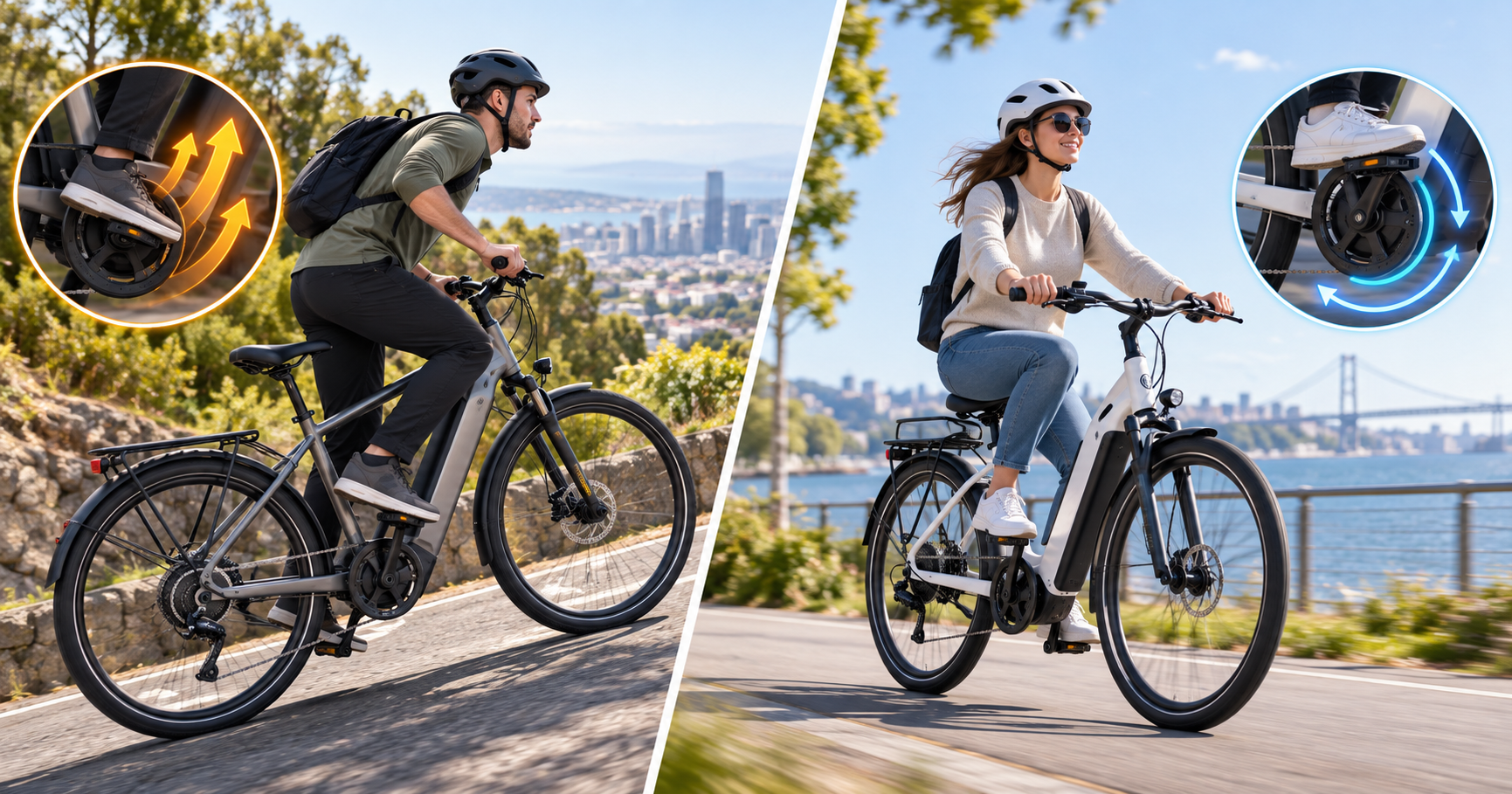
Torque sensors and cadence sensors can both make an eBike enjoyable, but they tell the motor different things. A torque sensor measures how hard you press the pedals, allowing assistance to rise and fall with your effort. A cadence sensor measures how fast the cranks are turning, allowing the controller to respond to pedaling motion or speed.
That difference often makes torque sensing feel as though your legs have become stronger. A cadence-sensing bike can feel more like the motor settles into a programmed level of help once you begin pedaling. But neither description is universal. The controller, motor, gearing and assist settings shape what you actually feel.
The short answer is simple: start with torque sensing if you want proportional, bicycle-like control. Start with cadence sensing if you prefer easy, steady help without having to press hard. Then test the complete bike before deciding.
Table of Contents
ToggleWhat Does a Torque Sensor Measure?
Bosch defines a torque sensor as measuring the force exerted on the pedals. The eBike controller can use that signal to vary motor support as your effort changes. Press harder to accelerate or climb and a well-tuned system can add more help. Ease off and the assistance can soften.
This is why torque-sensing eBikes are often described as natural or connected. You still choose an assist mode, but your legs remain part of the control. Instead of merely telling the bike that the cranks are moving, your pedal pressure helps tell it how much support you are asking for.
The label does not guarantee perfect response. Two torque-sensing bikes may react differently because manufacturers can tune support strength, startup dynamics, maximum motor torque and power delivery differently.
What Does a Cadence Sensor Measure?
A cadence sensor measures how fast the cranks turn. On many cadence-based eBikes, pedaling tells the controller to provide the support programmed for the selected assist level. Some systems mainly detect that you are pedaling, while others use crank speed more actively. Startup delay, power strength and cutoff behavior vary by bike.
Cadence sensing can reduce the need to push hard once the cranks are moving. Some riders value that easy, steady help. Others prefer motor support to follow their effort more closely, particularly when maneuvering slowly or changing speed often.
Avoid treating every cadence system as a crude on/off switch. The sensor supplies an input; the controller decides how to use it.
Sensor Type Is an Input, Not a Verdict
Bosch’s own system documentation separates support, dynamics, maximum torque and maximum power as different settings. That is a useful buying lesson. The sensor collects information, but the controller determines how assistance arrives.
Motor location, gearing, bike weight, wheel size, assist modes and software also change the ride. Two bikes with the same sensor type can feel surprisingly different. Some systems even combine torque and cadence information.
Decision callout: Never reject or buy an eBike on the sensor label alone. Use the label to choose what to test.
| Riding priority | Torque sensing may suit you if… | Cadence sensing may suit you if… | What to verify |
|---|---|---|---|
| Stop-and-go commuting | You want to control acceleration with pedal pressure | You prefer steady help after pedaling begins | Startup delay, surge and cutoff |
| Exercise | You want effort to remain connected to assistance | You want easier spinning with less pedal force | Lowest assist level and available tuning |
| Hills | You want support to build as you push | You prefer programmed help once the sensor engages | Motor output, gearing and hill-start response |
| Limited pedaling force | You can apply enough pressure and value fine control | You can rotate the cranks but do not want to press hard | Activation effort and low-speed control |
| Budget | You value response enough to pay for it when necessary | You find a well-tuned system that meets your needs at a comfortable price | Fit, brakes, service, battery documentation and total quality |
Commuting: Focus on Starts and Slow Control
For frequent stops, a well-tuned torque sensor can make acceleration easy to control. Light pressure can produce gentle help, while harder pressure can bring stronger acceleration. This may feel reassuring in traffic, on a shared path or around a tight turn.
A cadence system can also be a good commuter choice, especially if you want the motor to do more of the work after you start pedaling. Pay close attention to the first crank movement. Does assistance arrive when you expect it? Is it smooth enough for a crowded path? Does it stop promptly when you stop pedaling?
The answers tell you more than the sensor category. If you are still choosing between an everyday commuter and a more performance-oriented ride, ERN’s published commuter-versus-performance guide can help with that broader decision.
Exercise: Decide How Much Your Effort Should Control the Bike
Torque sensing tends to reward harder pedaling with more support, preserving a clear relationship between effort and acceleration. Lowering the assist mode can make you do more of the work without removing that proportional response.
Cadence sensing may suit someone who values movement and fresh air more than a tightly controlled workout. It can let you keep the cranks moving lightly while the system supplies steady help. Test the lower assist levels, though. You need to know whether the bike gives you the effort balance you want rather than assuming that its display settings will feel a certain way.
Hills: Do Not Confuse the Sensor With Climbing Ability
A torque sensor may feel intuitive on a hill because pressing harder can call for more support. A cadence system may provide substantial assistance after it recognizes crank movement. Neither fact proves that the eBike will climb well.
Climbing also depends on motor torque and power, gearing, wheel size, total load, traction, speed and the motor’s ability to manage heat. Try a restart on a safe, gentle incline if possible. A bike that climbs comfortably once moving may still feel awkward when starting uphill.
For a deeper look at motor torque and climbing demands, use ERN’s published high-torque hill guide rather than trying to decide hill performance from the pedal sensor alone.
Mobility Limitations: Test the Effort Needed to Get Help
Sensor choice can be especially important when knee, hip, strength or balance limitations affect pedaling, but there is no universal accessibility winner.
A cadence-based bike may be appealing if you can rotate the cranks but want assistance without pressing hard. The trade-off is that delayed or sudden engagement may feel uncomfortable at low speed. A torque-based bike may provide finer control, but you must be able to apply enough pedal force for that particular system and setting to respond comfortably.
Use a real test ride whenever possible. Practice starting, slowing, turning and restarting in a safe open area. Confirm whether assistance strength or startup response can be adjusted. Bike fit, step-through clearance, gearing and throttle availability may also matter, but those are separate buying questions.
If a health condition affects whether or how you can ride safely, use guidance from a qualified healthcare or adaptive-cycling professional alongside the test ride. This comparison cannot determine what is safe for an individual rider.
Budget: Pay for a Difference You Can Feel
You may encounter cadence sensing on many value-oriented eBikes and torque sensing promoted as an upgraded feature. That is a market pattern, not a rule, and it does not determine value.
A comfortable, serviceable cadence-sensing bike can be a better purchase than an ill-fitting torque-sensing bike with weak dealer support. Compare brakes, electrical-system documentation, fit, warranty, local service, parts availability and total weight alongside the sensor.
Spend more for torque sensing when you can feel and value the difference. Do not pay extra simply because the term sounds more advanced.
Does a Torque Sensor Automatically Improve Range?
No. Avoid any universal range promise based on sensor type alone.
A proportional system may reduce unnecessary assistance in some situations, but real range depends on battery capacity, motor and controller design, assist setting, speed, hills, wind, temperature, tire pressure, total load and repeated stops. Rider behavior can erase or reverse a theoretical advantage.
Use ERN’s published real-range guide to evaluate those variables. For this buying decision, treat any precise range advantage attributed only to the sensor as an unsupported shortcut unless the manufacturer provides comparable test conditions for the complete bikes.
How to Compare Both Systems on a Test Ride
If a dealer lets you compare two eBikes, use the same short route and roughly comparable assist levels. Start in a safe, open area and make five observations:
- Start: Notice how much crank movement or pedal pressure is needed before assistance begins.
- Slow control: Make a wide, slow turn and decide whether the support feels predictable.
- Stop and restart: Check how promptly assistance stops, then how smoothly it returns.
- Change your effort: Pedal lightly and then firmly. Does the response match what you want?
- Try a gentle incline: Check both a rolling climb and, if safe, a hill start.
Finally, reduce the assist level and see whether the bike remains comfortable to pedal. Do not chase the most dramatic boost. Look for support you can predict and control repeatedly.
Questions to Ask About the eBike You Are Considering
- Does this model use cadence sensing, torque sensing or both?
- How is assistance mapped across its available levels?
- Can startup strength or response be adjusted?
- How quickly does support begin and stop?
- Can I test a hill start and a slow turn?
- Who can diagnose or replace the sensor if it fails?
If the salesperson cannot answer, ask for the current manufacturer manual or support documentation. A clear specification is more useful than a vague promise that the system is “smooth” or “smart.”
Which Sensor Should You Choose?
Start with torque sensing if you want assistance to follow your effort, value fine control and prefer a bicycle-like connection. Start with cadence sensing if you prefer steady support once pedaling begins, want to minimize pedal force or find a better complete bike within your budget.
Then let the test ride make the final decision. A well-programmed controller, suitable motor, useful gearing, comfortable fit and dependable service can matter more than the sensor name. The right sensor is the one that provides predictable help for the way you actually ride.
Frequently Asked Questions
Is a torque sensor always better than a cadence sensor?
No. Torque sensing usually offers more proportional control, but some riders prefer the easy, steady assistance of a cadence system. Tuning, fit, motor behavior, service and price can outweigh sensor type.
Does torque sensing always give an eBike more range?
No. Sensor type alone cannot predict range. Battery capacity, motor and controller design, assist level, speed, terrain, weather, load and rider behavior all affect energy use.
Can an eBike use both torque and cadence sensing?
Yes. Official component documentation shows that combined cadence-and-torque systems exist. Ask the manufacturer or dealer how the signals are used because the presence of both still does not describe the complete response.