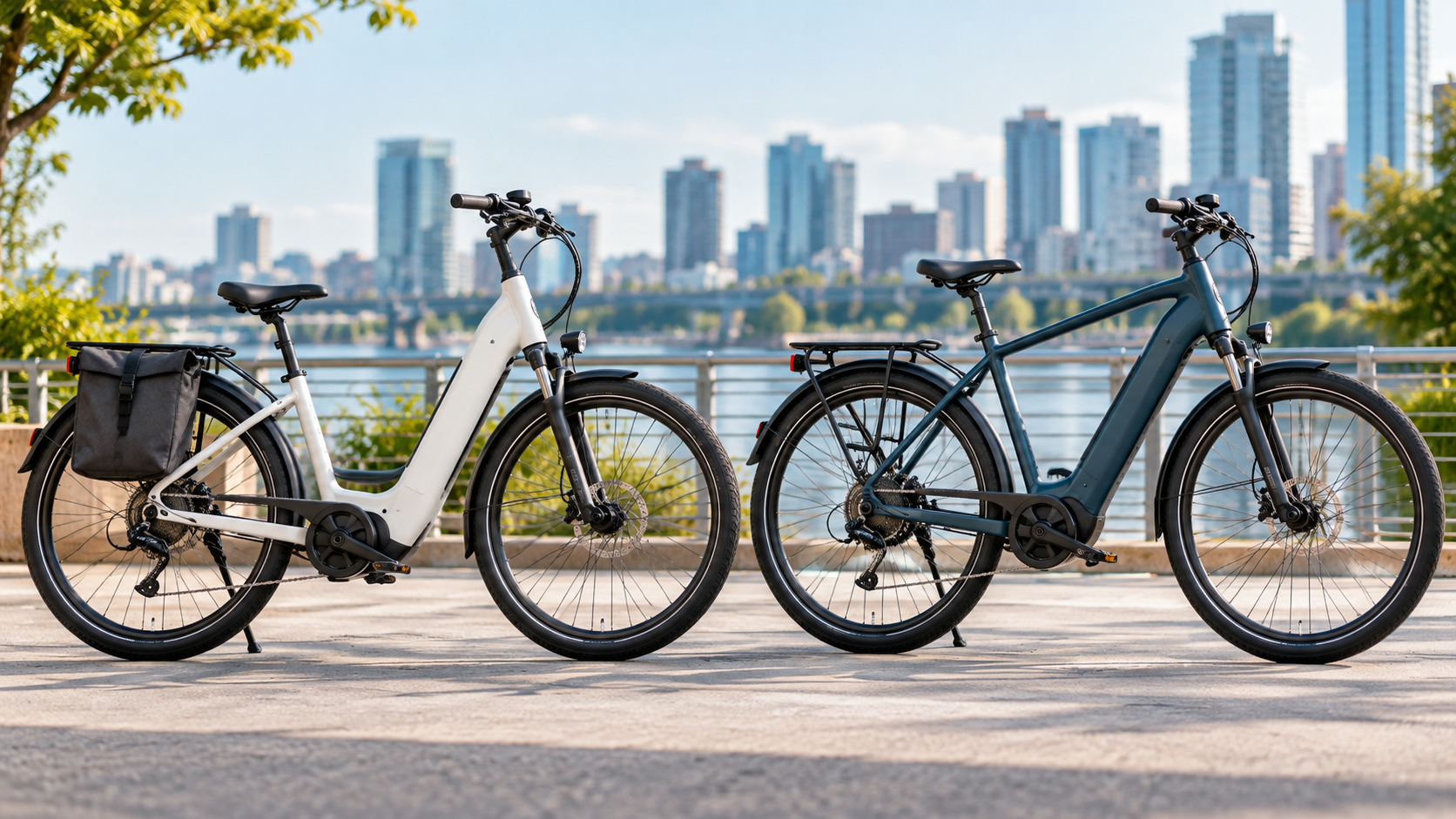
When comparing step-through vs. step-over eBikes, the better choice depends on how you ride. A step-through eBike is often more practical if you regularly get on and off, carry bulky cargo behind the saddle, or find a high leg lift difficult. A step-over can work just as well when you can mount it comfortably and the particular bike fits your riding and carrying needs. The better frame is the one you can use confidently throughout your day—not simply the one that looks stronger in a photograph.
Frame style mainly changes how you enter and leave the bike. It does not, by itself, tell you the bike’s load capacity, riding stability, comfort, or total weight. Those decisions require the specifications and fit of the actual model.
Table of Contents
ToggleWhat changes between step-through and step-over frames?
A step-over frame has a higher top tube, the tube running between the front of the frame and the saddle area. You need enough clearance to stand over it and a comfortable way to get onto the bike. A step-through lowers or removes that obstacle, leaving a more open space through which to lift your foot.
There is also a middle ground. Mid-step or stagger frames have a sloping top tube that lowers the opening without making it as open as a low-step design. Manufacturers use these names differently, so compare the actual opening and dimensions rather than shopping by label alone.
Do not assume a step-through is automatically upright or that a step-over is automatically sporty. Handlebar position, saddle position and the distance between them help determine your riding posture. Either frame style can be comfortable when the whole bike suits you.
Match the frame to the moments that matter
Think about the least convenient part of your regular ride: leaving a crowded bike room, stopping repeatedly on an errand route, clearing a bag on the rear rack, or getting the bike up a step at home. Frame choice becomes more useful when it solves that specific problem.
| Your everyday situation | Useful starting point | What to verify on the actual bike |
|---|---|---|
| Frequent errands and repeated mounting | Compare step-through first | Foot clearance, ability to hold the bike and restart comfortably |
| Tall or bulky rear cargo | Step-through may simplify access | Mounting path with the intended rack and bag installed |
| High leg lifts are difficult | A low opening is worth trying | Reach, brake access and control while stopped, not just entry height |
| You already mount a high frame comfortably | Either style can suit commuting | Complete fit, intended-use rating and accessory compatibility |
| Daily stairs or vehicle loading | Frame label is a weak guide | Actual carrying weight, approved grip points and lifting ability |
| Two people will share the bike | Compare the usable adjustment range | Each person’s reach, saddle setting and mounting clearance |
This table is a starting point, not a safety rating. A step-through that is too large or too heavy to manage can be a worse choice than a well-fitting step-over.
Repeated stops and commuter clothing
At an ordinary traffic stop, you may only need to put a foot down; you do not have to get completely off at every light. A low frame becomes especially useful when your day involves repeated full dismounts, such as locking up outside shops or opening a gate.
Try that movement in clothing you actually expect to wear. If your trousers limit a high leg lift, a low opening may remove a daily annoyance. Keep loose clothing clear of the chain, wheels and pedals with either frame.
Rear cargo changes the mounting path
A tall bag or basket behind the saddle can occupy the space where you normally swing your leg. A step-through may let you enter through the frame instead. That is an access advantage; it does not increase the rack’s capacity.
Ask a dealer to show the intended cargo setup before choosing. Check that your foot clears the opening and that your leg does not catch the bag. Begin with the bike unloaded, then discuss a controlled trial with a small, secured load. A full grocery load is a poor first test of an unfamiliar bike.
Mobility and stopped-bike control
If a high leg lift is uncomfortable or difficult, compare lower openings first. But entry is only one part of the decision. You also need to reach the brakes, steer, get a foot down and hold the bike upright when assistance is not moving you forward.
Motor assistance does not support a stopped bike. If a mobility limitation affects balance or strength, arrange a supported fit session rather than assuming a low frame settles the issue. An ordinary two-wheel step-through is not a balance aid.
Low access is not the same as correct fit
You may be able to step into a frame that is still too long, too tall at the saddle, or awkward at the handlebars. A low top tube can hide that mismatch if you judge fit only by whether you can stand over the bike.
Trek’s U.S. owner manual separates frame clearance from sizing and saddle adjustment. For its low-rise designs, it tells riders to verify sizing using the corresponding standard-frame geometry. The practical lesson is to check the entire fit, with help from the manufacturer or dealer.
On the actual bike, assess whether you can reach the grips and brake levers comfortably, pedal without feeling cramped or stretched, and stop using a technique appropriate to that bike. Ask the dealer to reconcile comfortable pedaling with controlled stops rather than using saddle height alone to compensate for the wrong size. Follow the model’s adjustment limits, including the seatpost insertion requirements.
If two people share the bike, both need a fit check. A large adjustment range is useful, but a low opening alone does not mean one size fits everyone.
Judge strength and cargo capacity by the ratings
Do not choose a step-over merely because you expect every high frame to be stronger. Tube dimensions, materials, joints and the complete design matter. A frame silhouette is not enough to rank two bikes for load capacity or durability.
Low-step cargo eBikes illustrate why that shortcut fails. Tern’s Quick Haul Long has a low step-through design and a published gross vehicle weight rating. That example shows that easy access and a purpose-built cargo design can coexist; it does not establish a rating for another step-through bike.
Read the capacity definitions carefully. A total-system or gross vehicle weight limit can include the bike and battery, accessories, rider and cargo. A manufacturer may define payload differently. Rear racks, front racks and individual bags or baskets can also have separate limits. You must satisfy every applicable limit, not just the largest number in the product description.
Tern’s official cargo guidance emphasizes secured loads and balanced placement. Follow the instructions for your own bike: where the load sits and whether it shifts matter to handling. A rated capacity is an upper limit, not a promise that every rider will find that load easy to control.
Separate mounting convenience from riding stability
Being able to get on easily can build confidence, but it does not prove that a bike will handle better while moving. Wheelbase, steering geometry, tires, weight distribution, cargo position and fit all contribute to how the actual bike behaves.
Compare controlled starts, gentle turns, braking and stops on a safe test route. For a commuter, these movements may tell you more than a short straight-line ride at higher speed. If steering feels uncertain or you struggle to hold the bike at a stop, ask for a fit check or compare another model before buying.
Keep the first ride unloaded. If cargo is part of the purchase, ask the dealer how to progress to a suitable loaded trial. Do not use a passenger as test cargo.
Check lifting, storage and transport before buying
Easy mounting does not mean easy carrying. A step-through can be heavy, and the open frame may change where you can safely grip it. A step-over’s top tube may look convenient, but it is not permission to lift or clamp the bike at any point you choose.
Check the complete bike weight in the configuration you will actually handle. If the manufacturer permits battery removal, ask how much it reduces the carrying weight and whether removal is convenient. Follow the battery-removal instructions; do not improvise around wiring or locks.
Measure the doorway, landing or vehicle space that matters. Ask for a supported demonstration rather than attempting a lift beyond your ability. If stairs remain impractical, consider a different model or access arrangement before purchasing.
For vehicle use, continue with transporting an eBike without a rack. If you use a car rack, confirm the rack’s and any adapter’s weight limits and attachment compatibility with the bike. Some systems need a frame adapter, while others hold the wheels; the rack maker’s instructions decide.
A useful test before you decide
Use this short sequence with a dealer or another appropriate source of support. It is practical shopping guidance, not a substitute for the bike’s manual or a professional fit.
- Check the size chart, intended-use rating, complete weight and capacity definitions.
- With assistance disabled and the bike supported as needed, mount and dismount without catching the frame, saddle or intended cargo accessories.
- Check reach, brake access and pedaling fit; have adjustments made within the manufacturer’s limits.
- On a safe, traffic-free route, try starts, gentle turns and stops using the maker’s operating instructions.
- Discuss a gradual cargo trial and verify home access, lifting and storage before buying.
If the low opening makes daily access easier and the whole bike fits, a step-through is a sensible commuter choice. If a step-over fits well and poses no mounting problem, there is no need to reject it. Choose the actual bike that passes your everyday-use checks, then treat frame style as one useful part of that decision.
Frequently Asked Questions
Is a mid-step frame a useful compromise?
It can be if its lower opening solves your mounting problem and the bike fits. Test the actual clearance: a sloping tube can still be too high for your comfortable movement.
Can I carry a passenger on either frame style?
Only if the manufacturer approves the bike and the required seating, support and protective accessories for that purpose. A high payload number or a sturdy-looking rack does not establish passenger compatibility.
Does a step-through make battery removal easier?
Sometimes, but the battery position, release mechanism and removal path determine that. Ask for a demonstration on the exact model, especially if you plan to remove it every day.