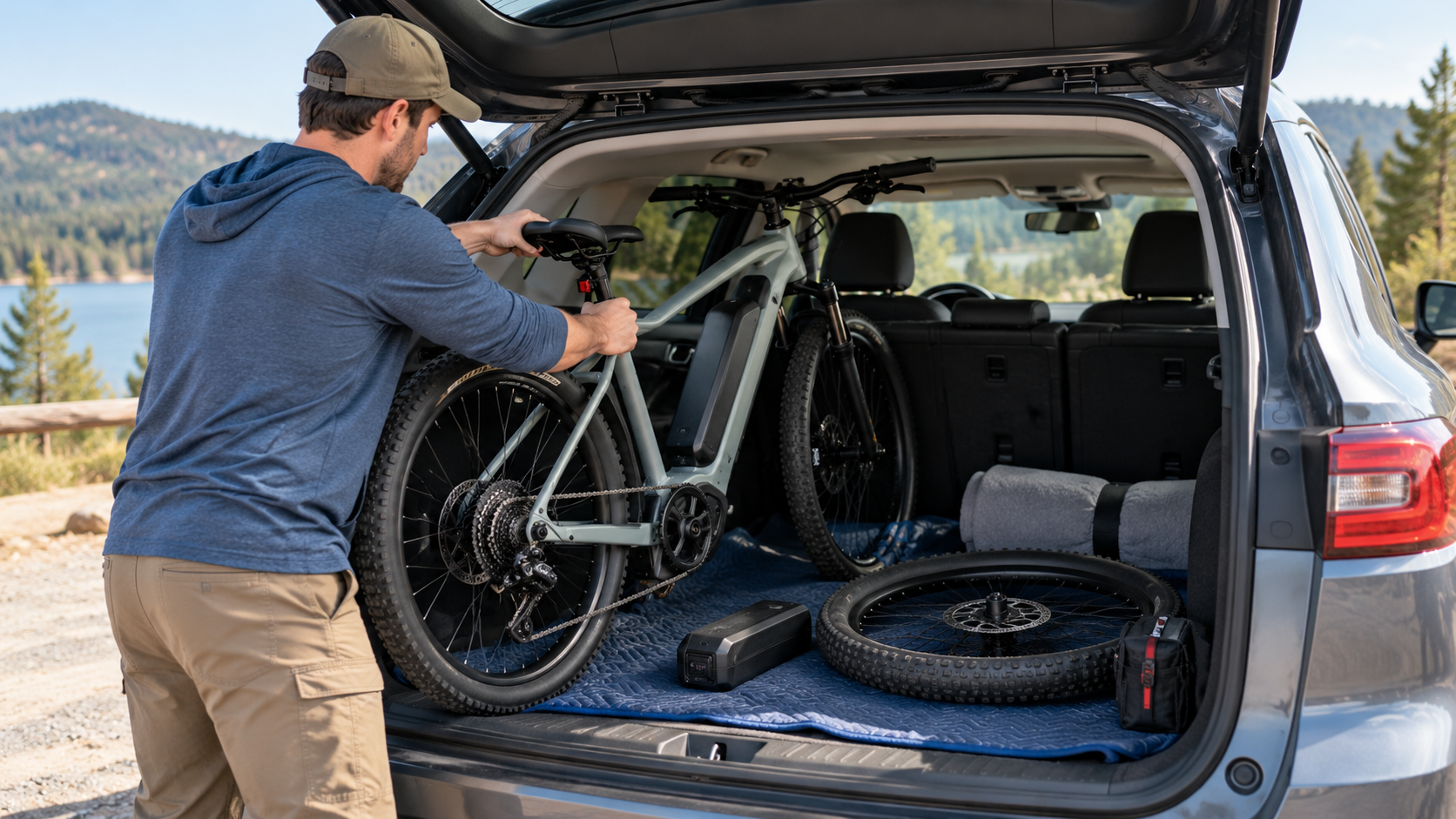
You can transport an eBike without a rack by carrying it inside a hatchback, crossover, wagon, or SUV when the bike fits safely and can be properly secured. For riders who do not own a hitch rack, only move a bike occasionally, or want the bike protected from weather and road spray, carrying it inside the vehicle can be a practical option.
The challenge is that an eBike is not just a larger bicycle. It is usually heavier, harder to maneuver through a cargo opening, and more vulnerable to damage at the derailleur, brake rotors, display, wiring, pedals, battery, and other contact points. Once it is inside the vehicle, it also becomes heavy cargo that needs to be restrained.
A good setup therefore starts before the bike is lifted. The key questions are simple: Will the bike pass through the cargo opening? Can you make it light enough to handle safely? Which parts need protection? And can the bike and anything you remove be secured so they cannot move during normal driving or sudden braking?
If the answer to the last question is no, carrying the bike inside the vehicle is not the right transport method.
Table of Contents
ToggleStart With the Opening, Not Just the Cargo Floor
It is easy to look at the folded rear seats and assume there is enough room. The cargo opening is often the real limitation.
Measure the hatch or door at its narrowest useful point, then compare that opening with the bike’s handlebar width, overall height, wheelbase, and the space created once the rear seats are folded. Wheel wells, trim, a sloping roofline, and the angle of the hatch can reduce usable space more than the published cargo-volume number suggests.
This is also the point to decide whether removing the front wheel would solve the fit problem. A bike that is several inches too long may become easy to load once the front wheel is removed, while another bike may still be too tall or wide because of the handlebars, tires, or frame geometry.
The goal is not to prove that the bike can be forced inside. It is to know that it can enter and leave the vehicle without being dragged against glass, trim, upholstery, or delicate bike components.
Reduce the Weight Before You Fight the Bike
If your eBike has a removable battery and the manufacturer permits normal removal for transport, taking it off can make a meaningful difference when lifting the bike.
Bosch recommends removing the battery for transport and safely carrying it in the car. The same principle is useful even when you are putting the bike inside the car: less weight makes the frame easier to control while you are leaning into a cargo area or guiding the bike through a hatch.
Once removed, however, the battery becomes a separate piece of heavy cargo. It should be stored so that it cannot slide, be struck by the bike or other luggage, or sit for prolonged periods in excessive heat. Follow the battery manufacturer’s instructions for transport and terminal protection.
You can also remove accessories that make the bike awkward to handle, such as panniers, baskets, a detachable display, or a heavy lock. The purpose is not to dismantle the bike unnecessarily. It is to make the lift simpler and reduce the number of things that can catch on the vehicle.
Decide Whether the Front Wheel Needs to Come Off
Removing the front wheel can be the difference between an eBike that will not fit and one that fits comfortably.
If you use this method, follow the bike manufacturer’s wheel-removal procedure. Quick-release and thru-axle systems are not interchangeable, and disc brakes require some care. Keep the axle with the bike, protect the rotor from being bent, and use the correct brake-pad spacer if the manufacturer calls for one when the wheel is removed.
The wheel should then be treated as cargo in its own right rather than placed loosely beside the frame. A padded wheel bag, blanket, or protected position can keep the rotor away from other items and prevent the wheel from shifting during the drive.
For someone who rarely removes a wheel, it may be worth practicing the procedure at home before relying on it at the side of a trailhead.
Plan the Lift Before You Pick Up the Bike
The most awkward part of interior transport is usually not driving with the bike. It is getting a heavy, bulky machine through the opening while bent over the bumper or cargo floor.
Prepare the vehicle first. Fold the seats, clear the cargo area, place the protective blanket or mat where the bike will rest, and decide which end of the bike will enter first. Think about where your hands will go and whether the battery or front wheel should be removed before you lift.
If the bike is still too heavy or awkward to control, that is useful information. Interior transport is only a good solution when you can load and unload the bike without depending on an unsafe lift or dragging expensive parts across the vehicle.
Protect the Drivetrain and the Car at the Same Time
When a full-size eBike is carried inside a vehicle, it will often need to lie on its side. In that situation, keeping the drivetrain and derailleur side facing upward is the safer default because the derailleur and hanger can be damaged if the bike’s weight rests on them.
Before lowering the bike, look at the actual contact points. Pedals, crank arms, handlebars, levers, axles, racks, fenders, and other hard parts can mark upholstery or trim. A moving blanket or cargo liner protects broad surfaces, while smaller pads can be placed between a specific component and the vehicle.
The same protection works both ways. It keeps grease and dirt off the interior while also preventing glass, seatbacks, or trim from pressing against vulnerable bike parts.
Secure the Bike as Cargo, Not as Luggage
Once the bike fits, the next question is whether it can be restrained.
A blanket protects surfaces, but it does not secure a 50-, 60-, or 70-pound object in a sudden stop. Use only cargo anchors or restraint points that the vehicle manufacturer identifies for that purpose, and follow any load limits or instructions in the owner’s manual.
The bike does not need to be crushed against the floor. It needs to be prevented from sliding forward, rotating sideways, striking the hatch or windows, or moving into an occupied seating area. Soft-loop straps or other suitable restraints can make it easier to secure the frame without putting a hard hook against painted or delicate surfaces, but the exact restraint method must suit both the bike and the vehicle.
Do Not Forget the Parts You Removed
A removed battery, wheel, seatpost, display, or other accessory may be smaller than the bike, but it can still cause damage if it is free to move.
Give each item a defined place. Keep the battery protected from impact. Position the wheel so the brake rotor is not supporting weight. Keep the axle and other small hardware somewhere they cannot disappear into the cargo area.
This sounds minor until you arrive at the trailhead with a secure bike and discover that the axle is under a seat or the battery key is buried under luggage.
Check the Driver’s Position Before You Close the Hatch
Interior transport stops being a good solution if it compromises normal vehicle operation.
Sit in the driver’s seat before leaving. Make sure the bike does not interfere with the front seats, controls, mirrors, or required visibility. Confirm that occupied seats and seatbelts remain usable and that nothing can slide into the front footwells.
Then close the hatch carefully. If closing it requires pressure against the bike, the setup needs to change.
Will an eBike Fit Inside Your Vehicle?
| Situation | Interior transport is promising | A rack or another method may be better |
|---|---|---|
| Bike passes through the cargo opening without force | Yes | No if it must be pushed against glass or trim |
| Front-wheel removal creates enough room | Often | No if removal is unfamiliar or the model-specific procedure is unclear |
| Removing the battery makes the lift manageable | Helpful | No if the bike remains too heavy or awkward |
| Approved cargo anchors can restrain the bike | Strong sign | Avoid relying on friction or wedging alone |
| Driver visibility and passenger space remain usable | Yes | No if normal vehicle operation is compromised |
| You transport the bike frequently | Possible | A properly rated rack may become more convenient |
Inside the Vehicle or on an eBike Rack?
Interior transport has a few real advantages. The bike is protected from rain, road spray, and highway debris. It is less visible during short stops, and you do not need to buy or store a heavy rack for occasional trips.
The tradeoff is cargo space and lifting difficulty. A large fat-tire eBike, cargo bike, or very heavy full-size model may simply be too awkward to move inside a vehicle regularly. Frequent transport can also make repeated wheel removal and seat folding tiresome.
If you transport the bike often, need the rear seats for passengers, or find the loading process difficult, a properly rated hitch-mounted eBike rack may be the better long-term solution. ElectricRideNerd’s How to Properly Use Car Racks for E-Bikes covers that alternative.
Give the Bike a Quick Check Before Riding
Transport can loosen or disturb parts even when the bike was secured carefully. After unloading, reinstall the battery and front wheel according to the manufacturer’s procedure, then make sure the wheel is seated correctly and the brakes operate normally.
Look over the derailleur, cables, display, and any component that may have been close to a contact point in the vehicle. A short check is especially important if the wheel was removed or the bike was carried on its side.
The point is not to perform a full maintenance inspection at every stop. It is to catch an obvious transport problem before you ride away.
Frequently Asked Questions
Can I lay an eBike on its side in an SUV?
Often, yes, provided the bike manufacturer does not prohibit it and the bike can be padded and restrained. If it is laid on its side, keeping the drivetrain and derailleur side upward is generally the safer orientation.
Should I remove the eBike battery before putting the bike in the car?
If the battery is designed to be removed and the manufacturer permits it, removal can reduce lifting weight. The battery should then be secured separately and protected from impact and excessive heat.
Can I transport an eBike with the front wheel removed?
Usually, but follow the manufacturer’s wheel-removal procedure. Protect the brake rotor, retain the axle, and use any required brake-pad spacer.
Can I transport an eBike without a bike rack?
Yes, if the bike fits inside the vehicle and can be loaded, protected, and restrained safely. For many hatchbacks, wagons, vans, and SUVs, interior transport can be a practical rack-free option. It becomes less attractive when the bike is very large or heavy, passengers need the rear seats, or the bike cannot be secured to suitable cargo anchors.
The Best Interior Setup Is the One That Does Not Move
Transporting an eBike inside a car or SUV can be an inexpensive and practical alternative to buying a rack, particularly for occasional trips.
The important part is not simply getting the hatch closed. Measure the opening, reduce weight where appropriate, protect the vulnerable parts, and secure the bike and anything you remove. If those steps can be done without compromising the driver, passengers, bike, or vehicle, interior transport can work very well.
If they cannot, an exterior transport system is the better tool.