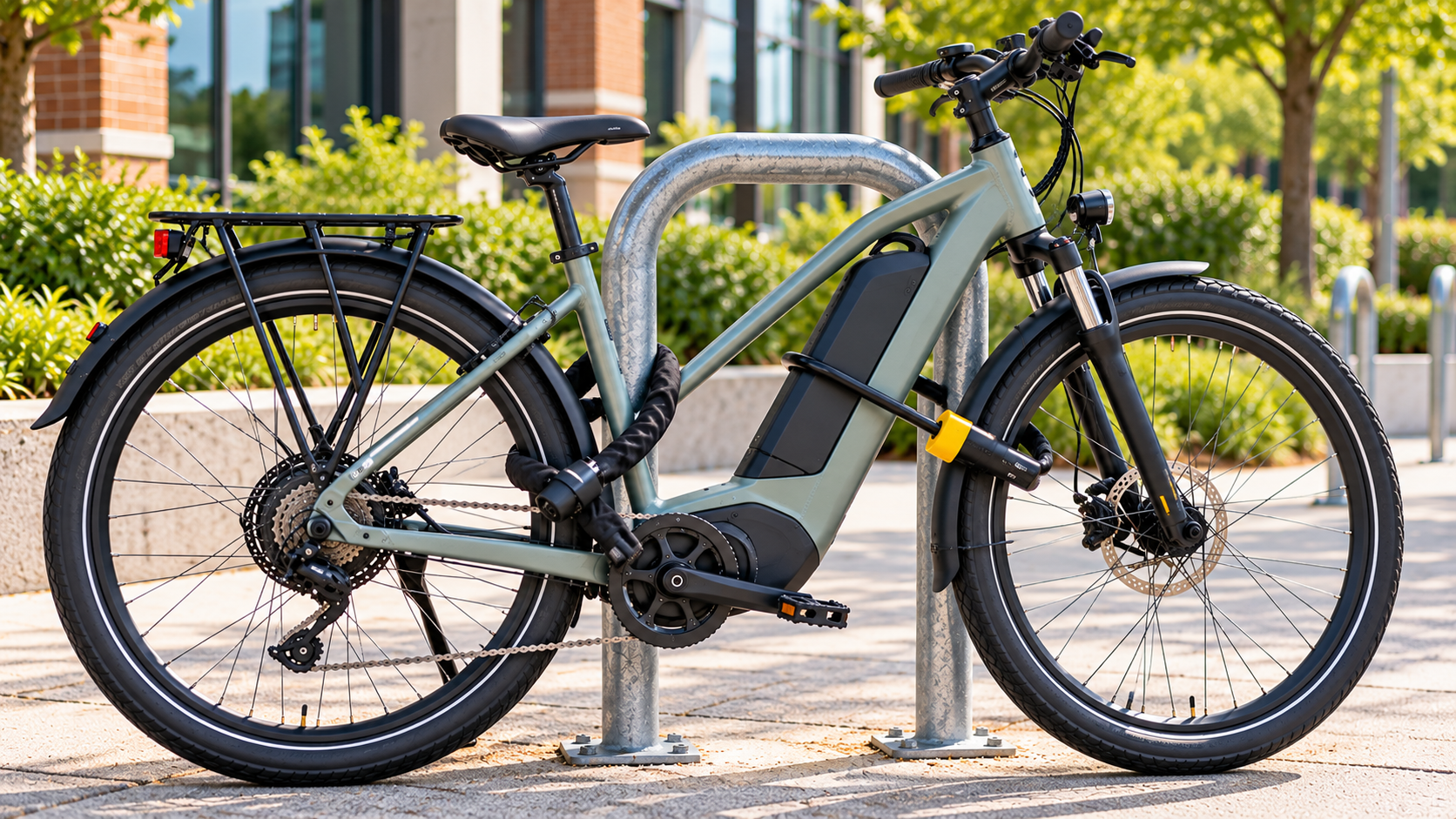
An eBike is heavier and usually more valuable than a conventional bicycle, but the basic locking goal is the same: connect the frame and vulnerable parts to a fixed object in a way that takes time, tools, and effort to defeat.
A practical public-parking setup uses two quality locks. Use the first lock to secure the frame and one wheel to a proper bicycle rack. Use the second lock to secure the other wheel and, when the shape of the bike allows it, connect that lock to the frame and rack too. Then decide whether the battery should stay locked to the bike or come with you.
This setup does not make an eBike theft-proof. It reduces easy opportunities and gives a thief more than one problem to solve.
Table of Contents
ToggleStart With the Right Place to Park
The strongest locks cannot compensate for a weak anchor. Choose a bicycle rack or another object that is firmly installed, made for locking bicycles, and cannot be lifted over or easily dismantled.
Before you lock up, give the rack a quick check. A loose rack, a cut rail covered by tape, or a short post that a bicycle can be lifted over is not a secure anchor. Avoid blocking sidewalks, ramps, doorways, or pedestrian routes.
Visibility helps, but it is not a guarantee. A busy, well-lit area may discourage casual tampering and makes it easier for you to check the bike. For longer stops, secure indoor parking or a staffed facility is preferable when available.
The Two-Lock Setup at a Glance
| Lock | Primary job | Best practical placement |
|---|---|---|
| Lock 1 | Protect the core of the bike | Frame plus one wheel to the rack |
| Lock 2 | Protect the remaining wheel and add a second barrier | Remaining wheel to the rack, including the frame where possible. If the rack cannot be reached, secure the wheel to the frame. |
At least one lock should be a rigid U-lock or D-lock sized closely enough to limit empty space. The second may be another U-lock or a quality chain, depending on the frame, wheel size, rack, and how much weight you can carry. A light accessory cable is useful for a low-value accessory, but it should not be treated as the main lock for an expensive eBike. Independent security ratings can help you choose locks appropriate to your eBike’s value and the risk of where you park.
Step 1: Put the Bike Close to the Rack
Position the bike so the frame is close to the fixed rack. Less open space inside a lock gives less room to insert tools or create leverage.
Keep the lock body and chain away from the ground when you can. A lock lying on the pavement can provide a firm surface against which someone can strike or position tools. Do not force the bike into a position that bends a brake rotor, pinches a cable, or places pressure on the derailleur.
Step 2: Lock the Frame and One Wheel
Pass the primary lock through a strong part of the main frame triangle and one wheel, then around the rack. On many step-through eBikes, the available frame opening is smaller, so you may need to lock around a substantial frame member rather than through a traditional diamond-shaped triangle.
Do not lock only a wheel to the rack. If the wheel can be removed, the rest of the eBike can be taken. Avoid relying on a seatpost, fender stay, cargo-rack rail, or another part that can be unbolted from the frame.
The rear wheel is often the more valuable wheel because it may include the motor or drivetrain. However, frame shape and rack position matter. The correct first lock is the one that securely captures the frame and a wheel without damaging the bike.
Step 3: Secure the Other Wheel
Use the second lock to capture the other wheel. Whenever the lock and rack geometry permit, include both the frame and the fixed rack. That produces two independent connections to the anchor.
If the second lock cannot reach the rack, connect the remaining wheel securely to the frame. This is less complete than anchoring both locks, but it makes the bike harder to roll away and protects a removable wheel.
Quick-release axles make wheel protection especially important. Even with thru-axles or bolted axles, a wheel can still be a target during a long stop.
Step 4: Decide What to Do With the Battery
The small key lock built into many eBike battery mounts is meant to retain the battery on the bike. It should not be assumed to offer the same protection as your main bicycle locks.
For a short stop in a relatively low-risk place, you may choose to leave the battery installed and locked according to the manufacturer’s instructions. For longer stops or higher-risk parking locations, consider taking the battery with you if it is designed for routine removal and you can carry it safely. Removing the battery reduces the value left on the bike, but always follow the manufacturer’s instructions to avoid damaging the battery or its mounting system. See how to store an eBike in an apartment safely.
If you remove it:
- Turn the system off first.
- Follow the owner’s manual so you do not damage the latch or electrical contacts.
- Protect the battery from drops, water, heat, and metal objects that could contact its terminals.
- Do not leave a loose battery in a hot vehicle.
- Reinstall it carefully and confirm that it is latched before riding.
If the battery is not easily removable, do not improvise by forcing the mount. Secure the eBike as well as possible and choose a lower-risk parking location.
Step 5: Remove Easy Targets
Take accessories that detach quickly. This may include a display, lights, phone holder, tool bag, pannier, helmet, action camera, or saddle on a quick-release clamp. Locking a helmet with a thin cable may discourage casual removal, but it is not the same as keeping it with you.
Record the eBike’s serial number and keep current photos. A prepared commuter may also want an eBike roadside safety kit for problems that happen away from the parking spot. Registration options vary by location, so check your police department or local bicycle program. Documentation cannot stop a theft, but it can improve the quality of a report and make ownership easier to establish.
Match the Setup to the Stop
A five-minute daytime stop and an overnight outdoor stop are not equal risks. Consider the value of the bike, how long it will be unattended, local conditions, the quality of the rack, and whether the location has controlled access.
For a quick stop, the two-lock method may be a reasonable balance between security and carrying weight. For several hours, remove accessories and consider taking the battery. For overnight storage, an indoor locked area and a fixed anchor are much better than leaving an eBike on a street rack.
No lock has unlimited resistance. If a location or duration feels wrong for the equipment you have, the safest decision may be to park somewhere else or take a different form of transportation.
A 30-Second Final Check
Before walking away, confirm five things:
- The rack is truly fixed and cannot be lifted over.
- The frame is connected to the rack.
- Both wheels are protected.
- Each lock has as little unused space as practical and is off the ground.
- The battery and removable accessories are handled according to the risk of the stop.
Give both locks a firm pull. Check that you have not trapped brake hoses or electrical cables and that the bike is not leaning where it could fall into traffic or block access.
The Bottom Line
The most useful locking routine is one you can repeat without guessing: choose a solid rack, put the bike close to it, secure the frame and one wheel with the primary lock, protect the other wheel with the second lock, and make a deliberate battery decision.
Two locks cannot promise that an eBike will still be there when you return. They can remove common weak points, add time and complexity, and make your bike a less convenient target.
Frequently Asked Questions
Should I lock an eBike by the wheel only?
No. A wheel can often be removed from the frame. At least one lock should connect a strong part of the frame to a fixed rack.
Is the battery key lock enough to secure the whole eBike?
No. The battery lock retains the battery in its mount; it does not secure the frame or wheels to an anchor.
Do I always need to remove the battery?
Not always. Base the decision on the stop length, location, battery design, carrying safety, and manufacturer instructions. Removal is more attractive for longer or higher-risk stops.
Can a cable be my second lock?
A cable may protect a low-value accessory or add limited wheel protection, but it is usually a weaker barrier than a quality chain or second U-lock. Match the second lock to the value of the eBike and the risk of the stop.