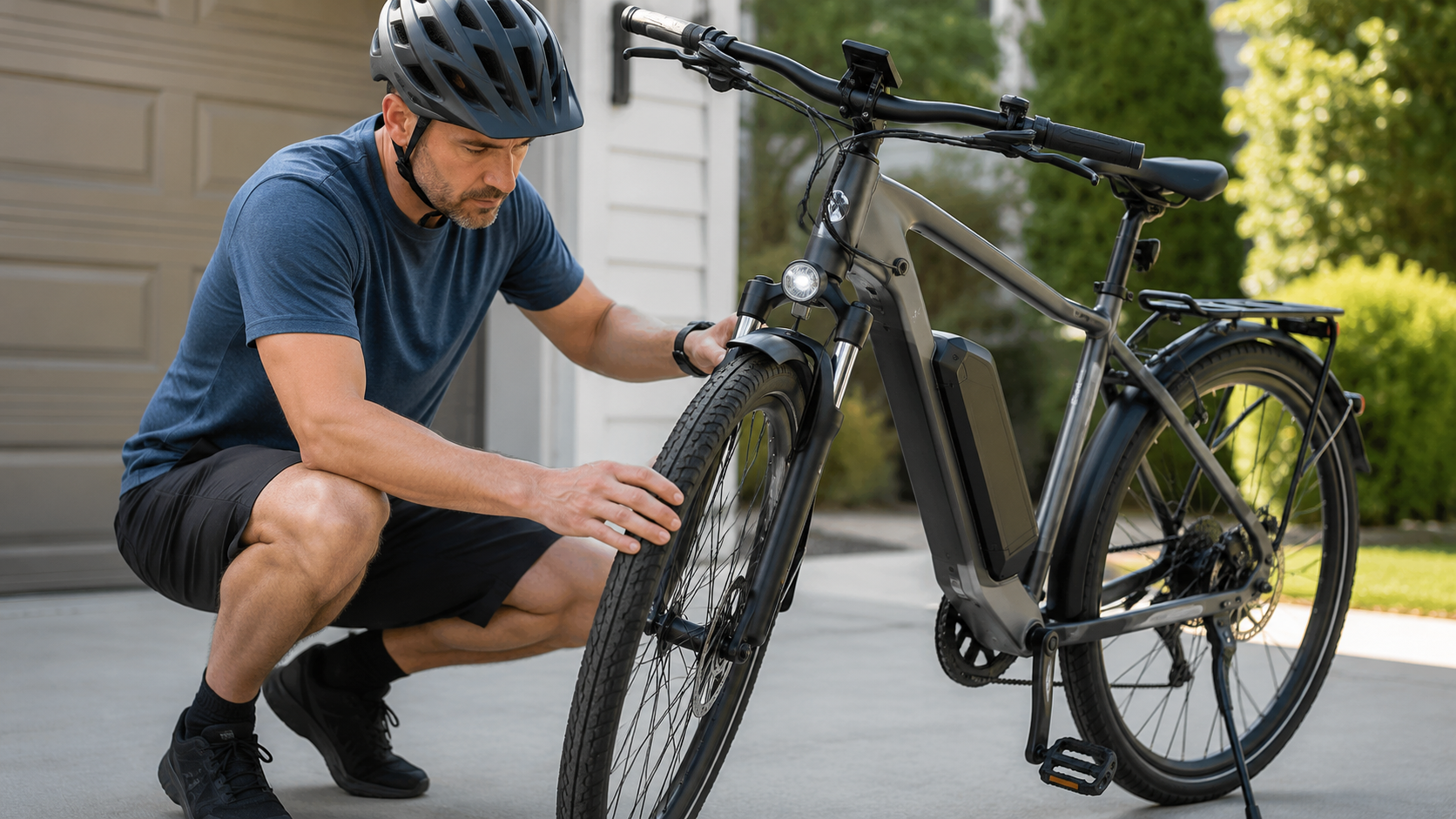
An eBike can feel ready to ride as soon as the display turns on and the battery shows a charge. But that does not always mean the bike is safe to ride.
Before you head into traffic, down a hill, or across town, take a few minutes to check the parts that matter most: tires, brakes, battery, lights, controls, and anything attached to the bike.
This is not a full maintenance routine. It is a fast safety decision before you ride.
The 5-Minute eBike Pre-Ride Safety Check helps you answer one simple question:
Is this eBike safe to ride today?
If you are new to eBikes, this quick check also fits into a larger beginner eBike maintenance routine. The pre-ride check helps you decide if the bike is safe today, while regular maintenance helps you prevent bigger problems over time.
Quick Answer: What Should You Check Before Riding an eBike?
Before every eBike ride, check your tires, brakes, battery, display, lights, handlebar controls, chain or belt, cargo, and accessories. Then do a slow test roll before riding normally.
If the tire is soft, the brakes feel weak, the battery looks damaged, the throttle sticks, or something feels loose, do not ride until you know what is wrong.
A good pre-ride safety check should take about five minutes. Once it becomes a habit, it feels as normal as putting on your helmet.
Why The 5-Minute eBike Pre-Ride Safety Check Matters
eBikes are still bicycles, but they carry extra speed, extra weight, and extra electrical parts. That means small problems can become more serious once the ride starts.
A soft tire can affect steering and increase the chance of a flat. Weak brakes can become a real problem when you are riding faster than expected. A loose rack, pannier, battery, or handlebar accessory can distract you or shift your balance while moving.
The idea behind The 5-Minute eBike Pre-Ride Safety Check is similar to NHTSA’s pre-ride bicycle check, which encourages riders to check key items like tire pressure and brakes before riding. For eBike riders, we add a few extra checks for the battery, display, motor controls, and attached cargo.
The goal is not to make riding feel complicated. The goal is to catch obvious problems before they turn into unsafe moments.
The 5-Minute eBike Pre-Ride Safety Check is especially useful before commuting in traffic, riding after storage, riding after rain, carrying cargo, riding in low light, or taking a longer ride than usual.
You do not need to be a mechanic to do this check. You only need to know what normal feels like on your own eBike.
The 5-Minute eBike Pre-Ride Safety Check
Use this simple routine before you ride.
| Time | Area to Check | What You Are Looking For | Ride Decision |
|---|---|---|---|
| Minute 1 | Tires and wheels | Proper tire pressure, no cracks, bulges, fast leaks, or major wheel wobble. | Do not ride if the tire is flat, badly damaged, or losing air quickly. |
| Minute 2 | Brakes | Firm lever feel, confident stopping, and no harsh grinding or scraping. | Do not ride if the brake lever pulls to the grip or the bike does not stop confidently. |
| Minute 3 | Battery and display | Secure battery, normal display, enough charge, and no damage or warning signs. | Do not ride if the battery is loose, swollen, hot, leaking, cracked, or giving off a strange smell. |
| Minute 4 | Lights and controls | Working front and rear lights, normal assist buttons, and no stuck throttle if equipped. | Do not ride in low light if your lights are dead or too weak to help others see you. |
| Minute 5 | Cargo and test roll | Secure accessories, steady steering, smooth start, normal braking, and no unusual sounds. | Do not ride if something feels loose, unstable, crooked, or unsafe during the test roll. |
This table gives you the rhythm. The sections below explain what each step means in real life.
Minute 1: Check the Tires and Wheels
Start with the tires because they are the only part of the eBike touching the road.
Give each tire a quick squeeze. It should feel firm, not soft or squishy. If the tire looks low, check the recommended pressure range on the tire sidewall or in your eBike manual. Do not guess if the tire is clearly underinflated.
Next, look over the tire surface. Check for cracks, bulges, glass, thorns, exposed threads, or anything stuck in the tread. If you ride a fat tire eBike, look carefully at the sidewalls too. The larger tire can sometimes hide damage near the rim.
Then look at the wheels. They should appear seated properly and should not wobble badly when they spin. If your bike uses quick-release levers, make sure they are closed and secure. Many eBikes use axle nuts or thru-axles instead, so the main idea is simple: nothing around the wheel should look loose, crooked, or out of place.
Do not ride if a tire is flat, badly cracked, bulging, or losing air quickly.
If you often find low pressure, cracks, or tire damage during this check, it may be time to learn more about eBike tire maintenance. Tires are easy to ignore, but they affect comfort, handling, range, and safety.
Minute 2: Squeeze Both Brakes
Your brakes are one of the most important safety systems on your eBike.
Stand beside the bike and squeeze the front brake lever. Then squeeze the rear brake lever. Each lever should feel firm and controlled. It should not pull all the way to the handlebar grip.
Now roll the bike forward slowly and apply each brake one at a time. The bike should stop smoothly and confidently. The brakes should not feel weak, delayed, or unpredictable.
Listen for new sounds. A light brake rub or small squeak can happen, especially after wet riding. But harsh grinding, scraping, or a metal-on-metal sound should not be ignored.
If a brake lever feels soft, pulls too close to the grip, or suddenly feels different from your last ride, pause before riding. That could point to worn brake pads, cable stretch, air in a hydraulic line, or another brake problem.
Do not ride if your brakes do not stop the bike confidently during a slow test.
If your brakes keep feeling weak, noisy, or inconsistent, that is no longer just a pre-ride check issue. It is time to look more closely at eBike brake maintenance or have the bike inspected by a qualified shop.
Minute 3: Check the Battery and Display
The battery is one of the main reasons eBikes need their own pre-ride safety check.
If your battery is removable, make sure it is seated properly and locked into place. Gently check that it does not rattle, slide, or shift in the mount. A loose battery can cause power cutouts, connection problems, or damage over time.
Look at the battery case. You are checking for visible damage, cracks, swelling, leaking, burn marks, melted plastic, unusual heat, or a strange smell. Most eBike batteries work safely when used as intended, but visible damage is never something to ignore.
For US riders, CPSC’s micromobility battery safety guidance is a useful safety reference because it covers eBikes, eScooters, hoverboards, and other lithium-ion powered rideables. The key takeaway for this article is simple: do not ignore signs of battery damage, and do not treat charging or battery problems casually.
For an added technical safety reference, UL’s eBike and eScooter battery safety information can help readers understand why damaged, modified, counterfeit, or poor-quality lithium-ion batteries deserve caution.
Turn the eBike on and check the display. Make sure the battery level is enough for your ride. Also look for warning icons, error codes, or anything that seems unusual.
This is also a good time to check your assist level. Many riders prefer to start in a low assist mode so the bike does not surge forward more strongly than expected.
Do not ride if the battery is loose, damaged, swollen, leaking, hot, giving off a strange smell, or showing a serious warning that you do not understand.
If battery issues show up more than once, do not keep guessing. A separate guide on eBike battery maintenance can help explain normal battery care, storage habits, warning signs, and when to ask for professional help.
Minute 4: Check Lights, Controls, and Visibility
A safe eBike is not only one that moves and stops. It also needs to be visible and predictable.
Turn on your front light and rear light. Even during the day, lights can help other road users notice you. If your lights use separate batteries, make sure they are charged or working before you leave.
If your eBike has a brake light, squeeze the brake lever and check that the light responds.
Now check the handlebar controls. Make sure the power button, assist buttons, display, bell, horn, and walk mode are working normally. If your eBike has a throttle, make sure it moves freely and does not stick.
Look at your mirrors if you use them. Make sure they are tight and aimed correctly before you start riding.
This is also a good moment to check your helmet. It should sit level on your head and feel snug without being uncomfortable.
If you want a broader safety refresher, NHTSA’s bicycle safety tips are a good US-focused resource for helmet fit, visibility, predictable riding, and basic road safety habits.
Do not ride in low light if your front or rear light is dead, missing, or too weak to help others see you.
Minute 5: Check Chain, Cargo, and Accessories
Before the final test roll, look at the parts that can loosen, shift, or get in the way.
Check the chain or belt area. The chain should not be hanging loose, jammed, badly rusted, or extremely dry. If your eBike has a derailleur, glance at the rear gears and make sure nothing looks bent or caught.
Check the pedals by hand. They should feel secure and should not wobble badly.
Now look at the parts attached to the bike. Check the seat, handlebar, stem, kickstand, fenders, rack, baskets, panniers, child seat, phone mount, water bottle cage, and cargo straps.
Loose accessories may not seem as serious as weak brakes, but they can still create problems. A loose pannier can swing into the wheel. A weak cargo strap can let a bag shift while turning. A loose child seat or rack should never be ignored.
If you are carrying cargo, make sure the load is balanced and secure before you ride away.
Do not ride if a rack, basket, child seat, handlebar, or cargo strap feels loose or unstable.
Riders who use their eBike for errands, commuting, or school drop-offs should pay extra attention to eBike cargo safety. Added weight changes how the bike feels when turning, braking, and starting from a stop.
Finish With a Slow Test Roll
The last part of The 5-Minute eBike Pre-Ride Safety Check is the test roll.
Start slowly in a driveway, parking area, or quiet space. Pedal gently. Listen for rattles, rubbing, clicking, scraping, or grinding. Check that the steering feels steady and the bike tracks normally.
Apply the brakes again at low speed. Make sure the bike stops the way you expect.
If the motor assist feels normal, the brakes work, the steering feels steady, and nothing sounds unusual, you are in a much better position to start your ride.
If the bike pulls to one side, cuts power, surges unexpectedly, makes a new grinding sound, or does not brake well, stop and check it again.
A slow test roll helps catch problems that are easy to miss when the bike is standing still.
Stop and Don’t Ride If You Notice These Problems
This is the most important part of The 5-Minute eBike Pre-Ride Safety Check. A small issue does not always mean your eBike needs major service, but problems with braking, steering, tires, battery safety, or control should be treated seriously.
Do not ride your eBike if you notice:
- A flat or badly underinflated tire.
- A tire with a bulge, deep crack, exposed casing, or fast air leak.
- A brake lever that pulls all the way to the grip.
- Brakes that feel weak, delayed, or unpredictable.
- A loose battery.
- A battery that is swollen, leaking, hot, cracked, melted, or giving off a strange smell.
- A stuck throttle.
- A display warning or error code you do not understand.
- A loose handlebar, stem, rack, basket, child seat, or cargo strap.
- A loud grinding sound from the brakes, motor, wheel, or drivetrain.
- A wheel that looks crooked, badly wobbly, or improperly seated.
ERN Safety Rule:
It is better to delay a ride than to discover the problem after you are already moving.
An Easy Way to Remember the Check
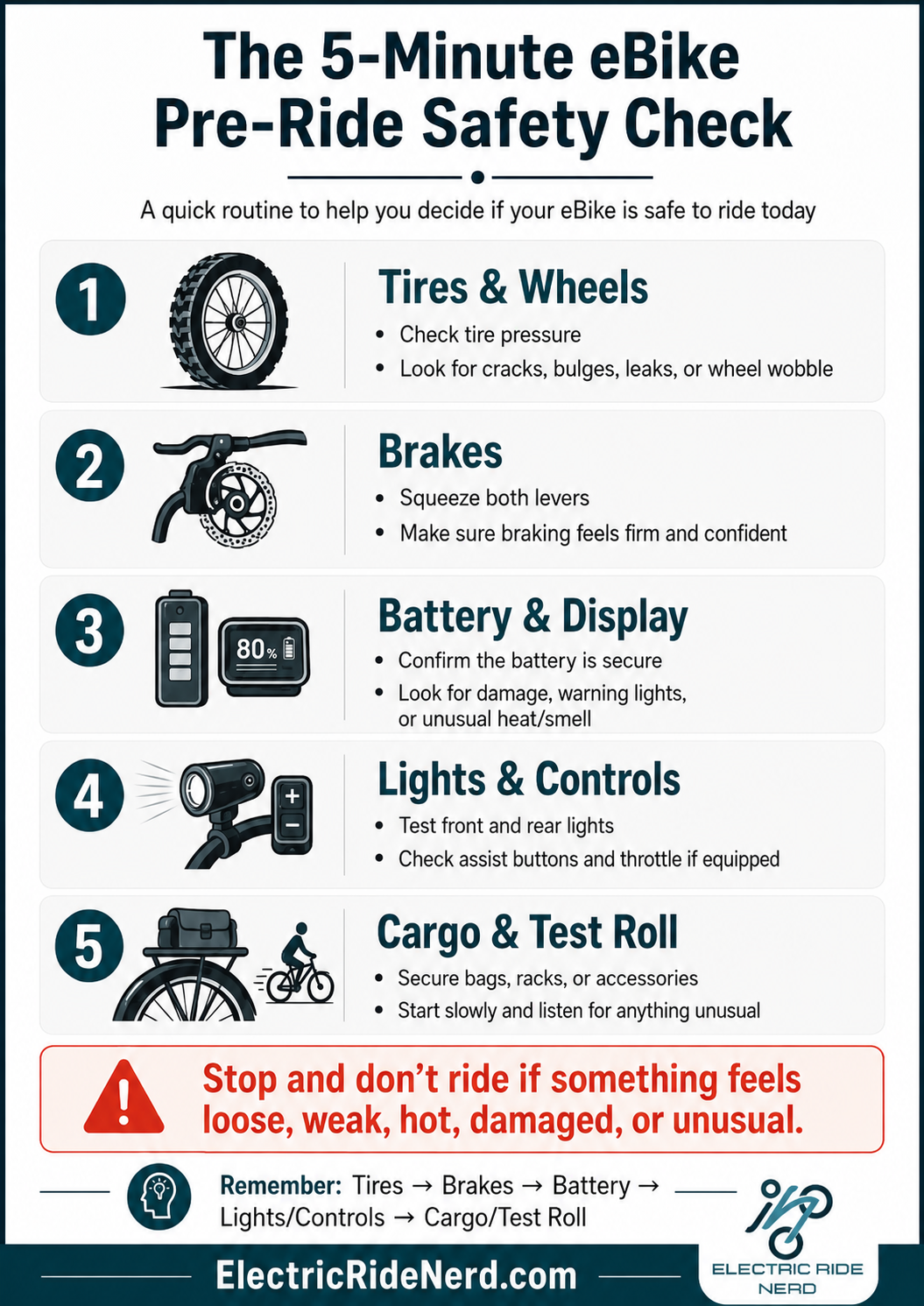
The 5-Minute eBike Pre-Ride Safety Check can be remembered with this simple order:
Tires.
Brakes.
Battery.
Lights.
Controls.
Cargo.
Test roll.
That is enough for most everyday riders.
You can say it in your head before each ride and move around the bike in the same order every time. After a while, the routine becomes quick and natural.
How Often Should You Do The 5-Minute eBike Pre-Ride Safety Check?
You should do a quick version before every ride.
That does not mean every ride needs a long inspection. If you ride daily, you may move through the check quickly. But the basics still matter: tires, brakes, battery, lights, controls, cargo, and test roll.
Use the full five-minute version before a commute, a longer ride, a ride in traffic, or a ride after storage.
You should also take a little extra time after wet weather. Rain, road spray, grit, and moisture can affect brakes, chains, tires, and electrical connections.
For a broader schedule, see our guide on how often you should service an eBike. That article explains how pre-ride checks, weekly checks, monthly checks, and deeper service work together.
Where This Fits in a Beginner eBike Maintenance Routine
The 5-Minute eBike Pre-Ride Safety Check is not meant to replace regular maintenance.
Think of it this way:
The pre-ride check helps you decide if the eBike is safe to ride today.
Weekly maintenance helps you catch small issues before they become bigger.
Monthly maintenance gives you time to inspect parts more carefully.
Seasonal maintenance helps prepare the bike for storage, weather changes, and heavier use.
That is why this routine fits naturally inside a beginner eBike maintenance routine. You are not trying to become a mechanic overnight. You are learning what your eBike feels like when everything is normal.
That matters because once you know what normal feels like, you can spot problems earlier.
Common Beginner Mistakes During a Pre-Ride Check
Many new riders skip the check because the eBike turned on. Power does not equal safety. The motor may work even if the tires are soft, the brakes are weak, or the rack is loose.
Another common mistake is only checking the battery level. Range matters, but battery charge is only one part of the ride. You also need to know that the battery is secure and that the bike can steer and stop properly.
Some riders also ignore small changes. A brake lever that suddenly feels softer, a new grinding sound, or a tire that keeps losing air should be treated as a warning.
The final mistake is rushing away without a test roll. A slow start gives you a chance to feel the bike before you are mixed with traffic, pedestrians, or faster riders.
What You Do Not Need to Check Before Every Ride
The 5-Minute eBike Pre-Ride Safety Check should stay simple. You do not need to inspect every bolt, remove the wheels, measure brake pad thickness, clean the drivetrain, or test every electrical connection before each ride.
Those jobs belong in weekly, monthly, or seasonal maintenance.
Before a normal ride, focus on the parts that affect safety right away:
Can the tires support the ride?
Do the brakes stop the bike?
Is the battery secure and normal-looking?
Do the lights and controls work?
Is anything loose or unstable?
Does the bike feel normal during a slow test roll?
That is the practical level most beginners need before riding.
Final Thoughts
The 5-Minute eBike Pre-Ride Safety Check is one of the easiest habits an eBike rider can build.
It is not complicated. It is not a full tune-up. It is not meant to replace regular service.
It is a quick way to decide whether your eBike is safe to ride today.
Check the tires. Squeeze the brakes. Look at the battery. Turn on the lights. Test the controls. Secure your cargo. Roll slowly and listen to the bike.
If everything feels normal, enjoy the ride.
If something feels wrong, stop before the ride gets harder to control.
That small habit can protect your eBike, your battery, your brakes, and most importantly, you.
FAQs About The 5-Minute eBike Pre-Ride Safety Check
Do I need to check my eBike before every ride?
Yes. It is smart to do a quick check before every ride. At minimum, check the tires, brakes, battery, lights, controls, and anything attached to the bike before you ride away.
How long should an eBike pre-ride check take?
A basic eBike pre-ride check should take about five minutes. Once you know the routine, many daily checks can be done even faster.
What is the most important thing to check before riding an eBike?
The brakes and tires should be checked first because they affect stopping, steering, and control. The battery is also important because a loose or damaged battery should not be ignored.
Should I ride if my eBike brake lever feels soft?
No. If the brake lever feels soft, pulls close to the handlebar grip, or feels different from normal, stop and inspect the brakes. If you are not sure what is wrong, have the bike checked before riding.
Should I ride with a damaged eBike battery?
No. Do not ride or charge an eBike battery that is swollen, leaking, cracked, unusually hot, giving off a strange smell, or showing burn marks. Follow the manufacturer’s instructions and contact a qualified service provider or local battery recycling or disposal authority.
Is a pre-ride safety check the same as regular eBike maintenance?
No. A pre-ride safety check is a quick habit before riding. Regular eBike maintenance is more detailed and includes cleaning, brake care, tire care, drivetrain service, battery care, and scheduled inspections.