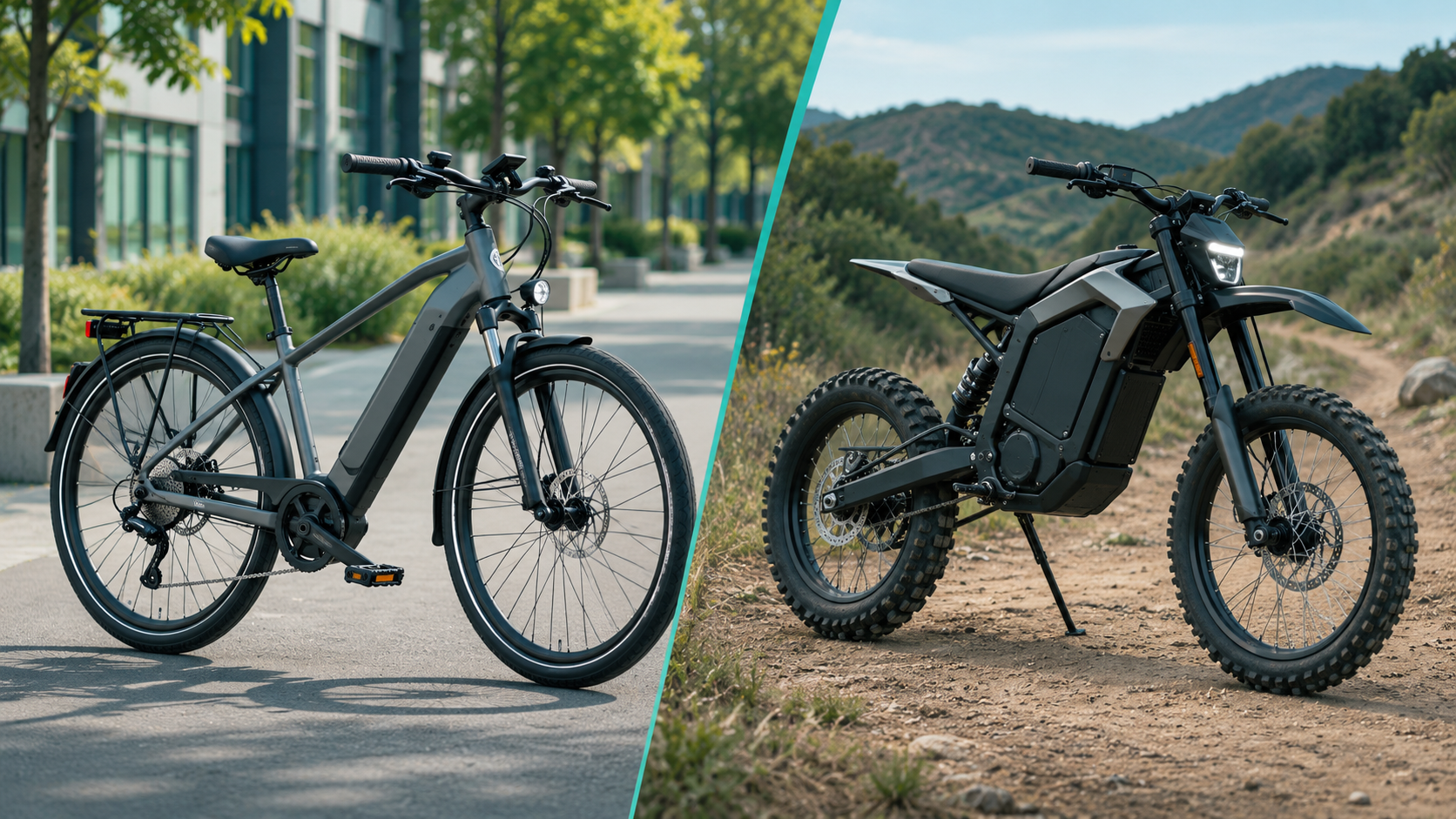
Are high-powered eBikes legal? Yes—some are. But a large motor number, a 28 mph claim, pedals, and the word “eBike” on a product page do not answer the legal question by themselves. The key is whether the machine fits the electric-bicycle definition where it will be used and whether that location allows its class.
In the United States, federal product rules, state vehicle laws, and local trail or road rules can all matter. They do not always answer the same question. Start with the machine’s actual specifications and behavior, then check the current rules for the state, city, road, bike path, park, or trail where you plan to ride. If the class labels are unfamiliar, use our guide to identifying your eBike’s class first.
Table of Contents
ToggleThe 750-Watt Number Is Only One Boundary
The U.S. Consumer Product Safety Commission defines a low-speed electric bicycle for federal bicycle product requirements as a two- or three-wheeled vehicle with fully operable pedals, a motor of less than 750 watts, and a motor-only maximum speed below 20 mph under specified test conditions.
That definition matters, but it is not a nationwide permission slip for every road or trail. Federal product classification addresses how a product is regulated. States and local authorities generally control how and where a vehicle may be operated.
This is why a seller’s “750W” badge is incomplete evidence. You also need to know whether the number is nominal or peak power, whether the machine has operable pedals, how the throttle behaves, when motor assistance stops, and how your jurisdiction classifies the vehicle.
Why 20 mph and 28 mph Both Appear in eBike Rules
Many states use a three-class system. California provides a clear example:
- Class 1: Motor assistance operates only while the rider pedals and stops at 20 mph.
- Class 2: A throttle may power the bike without pedaling, but motor assistance stops at 20 mph.
- Class 3: Assistance operates only while the rider pedals, the bike includes a speedometer, and assistance stops at 28 mph.
California also permits limited start assistance or walk mode on Class 1 and Class 3 eBikes at up to 3.7 mph. That limited function should not be confused with a throttle that powers ordinary riding speeds.
Under California law, all three eBike classes must have a motor that does not exceed 750 watts. That is different from the federal product definition’s “less than 750 watts” wording. A 28 mph pedal-assist bike can still be a legal Class 3 eBike in California, but not every 28 mph machine is Class 3. A throttle that continues beyond the local Class 2 limit, a motor outside the jurisdiction’s power limit, or a design capable of powered travel beyond the class boundaries can put the machine in another category.
The practical question is not “Can it reach 28 mph downhill?” A bicycle can exceed its assistance cutoff through gravity or rider effort. The question is when the motor stops providing power and whether the controls match the legal class.
Where an eBike Starts Looking Like an eMoto
“eMoto” is a market description, not one universal legal category. It commonly describes a motorcycle-shaped electric vehicle with high power, high speed, a prominent throttle, or token pedals added to resemble an eBike.
California added a specific definition for an off-highway electric motorcycle, commonly called an eMoto, effective January 1, 2026. The definition covers certain manufacturer-designed, off-highway, two-wheeled electric motorcycles with handlebars, a straddle seat, and no manufacturer-equipped pedals. These machines are subject to off-highway vehicle identification requirements; they are not automatically approved for public-road use. The market term is broader, so the name alone does not establish the legal category. See California Vehicle Code §436.1 and the California DMV’s motorcycle and moped guidance.
A machine is more likely to fall outside ordinary eBike rules when it has one or more of these characteristics:
- Motor assistance continues beyond the local eBike speed limit.
- The motor exceeds the jurisdiction’s permitted rating.
- The pedals are absent, nonfunctional, awkward to use, or clearly not central to the design.
- The machine is sold primarily for off-road or private-property use.
- Its manufacturer describes it as a motorcycle, moped, off-highway vehicle, or non-street-legal vehicle.
Once a machine leaves the electric-bicycle category, it does not automatically become legal as some other vehicle. It may need registration, a vehicle identification number, insurance, required lighting and mirrors, an appropriate driver licence, or other equipment. Some out-of-class machines cannot be registered for public-road use at all.
A Simple Classification Check
Use this as a screening tool, then confirm the actual rule where you ride.
| Question | Why it matters |
|---|---|
| Does it have fully operable pedals? | Many eBike definitions require them. Decorative or impractical pedals may not solve a classification problem. |
| What is the motor’s rated power? | The relevant law may use a watt limit. Do not substitute peak marketing power for the rating the law specifies. |
| Does it have a throttle? | Throttle use can change the class or be restricted in certain locations. |
| At what speed does motor assistance stop? | Motor cutoff, not just the display’s top speed, is central to many class definitions. |
| Is assistance above 20 mph pedal-only? | In three-class systems, this commonly separates Class 3 from throttle-assisted operation. |
| What does the manufacturer certify it as? | Labels, manuals, and compliance documents are stronger evidence than a marketplace title. |
| Where will you ride? | A road, bike path, park, and natural-surface trail can have different access rules. |
Modifying the Speed Limit Can Change the Legal Status
Removing a speed limiter, installing a higher-power controller, changing firmware, or altering a throttle can change how the vehicle operates. Even if the original model was sold as a compliant eBike, the modified machine may no longer fit its original class.
California Highway Patrol guidance, for example, explains that a purchased or modified device capable of powered travel above 28 mph is not treated as an eBike for California public-road use. Other jurisdictions use different wording and thresholds, so check locally before changing settings or hardware.
There is also a safety issue. Higher speed increases stopping distance and crash energy. Brakes, tires, frames, and battery systems should not be assumed suitable for performance beyond the manufacturer’s design. Do not treat a software unlock as a harmless menu preference.
How to Check Before You Buy or Ride
First, get the manufacturer’s current specification sheet and manual for the exact model and model year. Record the rated motor power, throttle behavior, pedal-assist cutoff, and any road-use certification or restriction.
Second, identify the state’s current electric-bicycle definition and classes. Use an official legislature, motor vehicle department, transportation agency, police, or parks source rather than relying only on a seller’s summary.
Third, check the specific place you will ride. Cities, parks, trail managers, campuses, and private landowners may impose additional restrictions even when the bike is legal on public roads.
Fourth, confirm the rules that attach to the class: minimum age, helmet requirements, passenger rules, path access, and equipment. If the machine may be a moped or motorcycle, check registration, insurance, and licence requirements before using it in public.
Finally, save the model documentation and any compliance label. If a product page is vague about nominal power, motor cutoff, or legal classification, treat that uncertainty as a buying risk.
Once you have confirmed that your eBike meets local riding requirements, make sure it is also mechanically ready for regular use. Having the right equipment for routine tire pressure checks, inspections, and basic maintenance can help you keep your bike in good working condition. Our guide to essential eBike maintenance tools explains what you need without buying unnecessary equipment.
Frequently Asked Questions
Is a 750W eBike automatically legal?
No. Power is only one part of the classification. Pedals, throttle operation, motor cutoff speed, and state or local definitions also matter.
Is a 28 mph eBike legal?
It can be. In many three-class systems, a pedal-assist bike that stops assisting at 28 mph is Class 3. Access, age, and helmet rules may be more restrictive, and the rule varies by jurisdiction.
Does adding pedals make an eMoto an eBike?
Not necessarily. The pedals must satisfy the applicable definition, and the motor power, throttle, and assistance speed must also comply. A product label cannot override how the vehicle actually operates.
Can I ride an out-of-class eBike on private property?
Possibly, with the property owner’s permission and subject to local rules. Private-property use does not make the machine legal on roads, bike paths, parks, or public trails.
Final Takeaway
High-powered eBikes are not all illegal, and 28 mph does not automatically mean “motorcycle.” The safest way to classify a machine is to check its operable pedals, rated power, throttle behavior, and motor-assistance cutoff, then confirm the current rules for the exact place you plan to ride. If the specifications are vague or the machine exceeds the local eBike boundary, do not assume the “eBike” name protects you.