
In recent years, electric skateboards have gained immense popularity as a mode of personal transportation. Combining the thrill of traditional skateboarding with the convenience of electric power, these innovative devices offer numerous benefits for riders. Whether you’re a daily commuter or a weekend adventurer, owning an E-Skateboard can greatly enhance your mobility and overall experience.
In this article, we will explore the top 10 benefits of owning an electric skateboard and how they can positively impact your lifestyle.
Electric skateboards can be a fun, compact, and surprisingly useful way to move around town. For the right rider, they can make short trips easier, reduce the need for a car on small errands, and add a little excitement to an ordinary commute.
But an electric skateboard is not the right choice for everyone. It does not offer the same stability as an eBike, the same beginner-friendly feel as many eScooters, or the same cargo space as a larger electric ride. It also requires balance, braking practice, safety gear, and a clear understanding of where you are legally allowed to ride.
So, are electric skateboards worth it? For short-distance riders who want a portable electric ride and are willing to learn safely, the answer can be yes. For riders who need maximum comfort, storage, wet-weather performance, or a more stable platform, an eBike or eScooter may be a better fit.
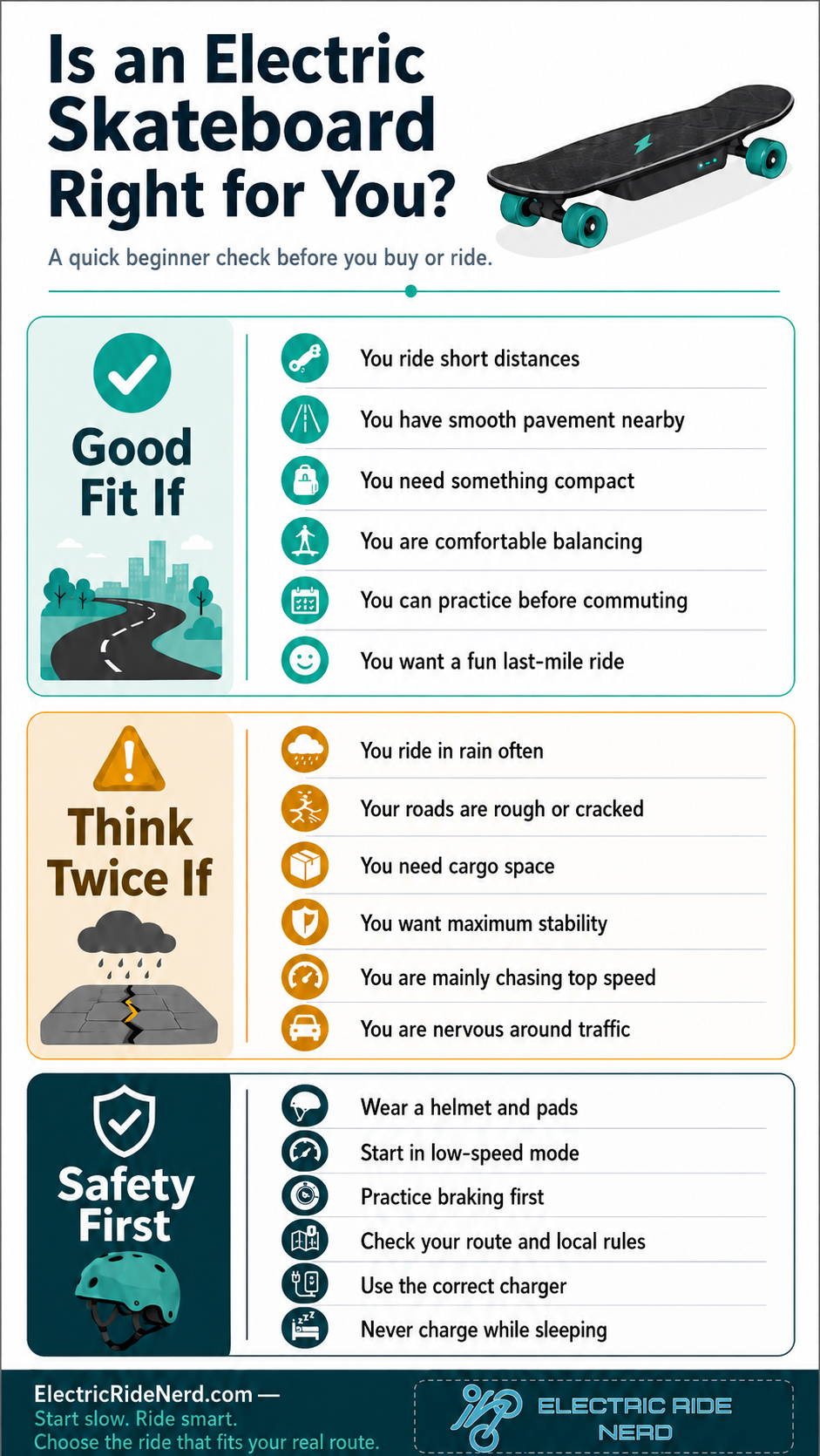
Quick Answer: Are Electric Skateboards Worth It?
Electric skateboards are worth considering if you want a lightweight, portable ride for short trips, campus travel, urban commuting, or recreational riding. They are especially useful when you need something smaller than an eBike and easier to carry than many eScooters.
But they are not the right choice for every rider. Electric skateboards require balance, braking practice, protective gear, and a safe route. Faster and higher-powered boards can also raise the risk because mistakes happen at higher speeds and crashes can be more serious.
Micromobility safety data also deserves attention. Federal safety reporting has tracked injuries and deaths connected with micromobility products, and the same beginner lesson applies here: speed, poor road conditions, weak protective gear, and poor rider judgment can turn a small ride into a serious injury risk.
For beginners, the best electric skateboard is not always the fastest one. A predictable board with smooth braking, stable handling, beginner speed modes, reliable battery information, and good customer support is usually a smarter choice than a board chosen only for top speed.
Electric skateboards are not ideal if you are uncomfortable balancing on a board, need to ride in heavy traffic, regularly travel in wet weather, or need to carry groceries, work gear, or a passenger. An electric skateboard can be practical, but it is still a skill-based electric ride. That means rider judgment matters.
ERN Reality Check
An electric skateboard can be fun and useful, but it should not be treated like a toy. Start slow, wear protective gear, practice braking before riding in public, and be cautious with high-speed or high-powered boards until your skill level matches the machine.
10 Real Benefits of Owning an Electric Skateboard
1. Electric Skateboards Are Easy to Store
One of the biggest benefits of an electric skateboard is how little space it takes up. Unlike an eBike, you usually do not need a rack, garage space, or large storage area. Many boards can fit under a desk, in a closet, or near an apartment door.
This makes an electric skateboard appealing for students, apartment dwellers, office workers, and anyone who wants a personal electric ride without dealing with bulky storage.
2. They Can Be Useful for Short Commutes
Electric skateboards work best for short trips where walking feels too slow but driving feels unnecessary. A ride to school, a coffee shop, a transit stop, or a nearby office may be exactly the kind of trip where an electric skateboard makes sense.
They are especially useful for “last-mile” travel. That means the short distance between a train station, bus stop, parking area, or campus building and your final destination.
3. They Are More Portable Than Many Electric Rides
Portability is one of the strongest reasons to choose an electric skateboard. Many riders like that they can pick up the board and carry it into a building instead of locking it outside.
This does not mean every board is light. Some long-range or all-terrain electric skateboards can be heavy. Still, compared with many eBikes and larger eScooters, an electric skateboard is usually easier to carry, store, and move through tight spaces.
4. They Can Reduce Some Transportation Costs
An electric skateboard can reduce small transportation costs when it replaces short car trips, paid parking, rideshares, or public transit fares. Charging an electric skateboard battery usually costs far less than fueling a car.
That said, the board itself is not free to own. You still need to budget for safety gear, replacement wheels, belts or drivetrain parts on some models, battery care, and possible repairs. The cost savings are most realistic when the board replaces trips you already make often.
5. They Make Short Trips More Fun
Many riders choose electric skateboards because they are enjoyable. The feeling of carving, accelerating, and gliding through a quiet route is a big part of the appeal.
This matters because the best electric ride is often the one you actually want to use. If an electric skateboard makes a short trip feel fun instead of annoying, you may be more likely to leave the car parked for small errands or local travel.
6. They Are Quiet and Low-Emission at the Point of Use
Electric skateboards are quiet compared with gas-powered transportation, and they do not produce exhaust while you ride. For short urban trips, that makes them a cleaner and less disruptive option than using a car for every small journey.
The environmental benefit depends on how the electricity is produced, how long the board lasts, and whether it actually replaces car trips. Still, for short-distance personal transportation, electric skateboards can be part of a lower-emission lifestyle.
7. They Can Save Time in the Right Setting
In the right environment, an electric skateboard can save time. This is most true on campuses, paved paths where riding is allowed, large work sites, and short urban routes with predictable pavement.
The time savings are not automatic. Rough roads, traffic, stop-and-go intersections, crowds, poor weather, or strict local rules can reduce the advantage quickly. A board is fastest and most useful when the route is simple, legal, dry, and familiar.
8. They Help You Learn Better Balance and Control
Riding an electric skateboard still requires balance, posture, and control. Even though the motor does the pushing, the rider still has to manage stance, turning, braking, road vibration, and unexpected bumps.
This can make electric skateboarding more physically engaging than some other electric rides. It is not a full workout in the same way as cycling or running, but it does require attention and body control.
9. They Are Great for Simple Recreational Riding
Not every electric skateboard has to be a commuter vehicle. Some riders use them mainly for recreation. A quiet ride through a smooth neighborhood, park path, or open paved area can be the whole point.
For recreational riders, the benefit is not just transportation. It is the experience. Electric skateboards can make local exploring more enjoyable when used in safe, legal areas.
10. They Give Riders Another Option Besides a Car
The best use for an electric skateboard is not replacing every form of transportation. It is adding another option. Instead of driving two minutes to a nearby store, waiting for a ride, or walking a long distance across campus, a rider may be able to use a board instead.
For people who live in walkable areas, near transit, or close to school or work, that extra option can be valuable.
Where Electric Skateboards Fall Short
Electric skateboards have real benefits, but they also have real limits. This is where many beginner articles are too optimistic. Before buying one, it is important to understand what an electric skateboard does not do well.
They Are Not as Stable as eBikes or eScooters
An electric skateboard has no handlebars, no seat, and a smaller platform than most eScooters. That makes rider skill more important. A new rider needs time to learn how to accelerate, brake, turn, and handle rough pavement.
If you want the easiest beginner electric ride, an electric skateboard may not be the first choice. An eBike or eScooter usually feels more stable for most beginners.
Wet Weather Can Be a Serious Problem
Many electric skateboards are not designed for regular rain riding. Wet pavement reduces traction, makes braking less predictable, and can increase the chance of damaging electrical parts if the board is not properly rated for water exposure.
Even if a board is described as water-resistant, that does not mean it should be treated like a rain commuter. Beginners should be cautious about wet roads, puddles, and winter conditions.
Road Quality Matters More Than People Expect
Small wheels and rough pavement do not mix well. Cracks, potholes, gravel, leaves, railroad tracks, and uneven sidewalks can all become problems on an electric skateboard.
All-terrain boards can handle more, but they are usually heavier and more expensive. For most riders, a smooth and predictable route is one of the most important parts of deciding whether an electric skateboard makes sense.
Range Claims Can Be Optimistic
Electric skateboard range depends on the battery size, rider weight, speed, hills, wind, temperature, tire type, pavement, and riding style. This is why ERN recommends thinking in terms of real-world electric ride range instead of trusting the headline range number alone.
For commuting, it is smart to leave a safety margin. If your round trip is 8 miles, a board advertised for 10 miles may feel too close. A board with more comfortable range gives you room for hills, detours, colder weather, and battery aging.
Local Laws Can Be Confusing
Electric skateboard rules are not the same everywhere. Some places allow them under certain limits. Other places restrict them on public roads, sidewalks, paths, trails, campuses, or public property. Rules may also differ between a state, province, city, campus, park, or private property.
Before using an electric skateboard for commuting, check your local rules. Do not assume that eBike or eScooter rules automatically apply to electric skateboards.
Electric Skateboard vs eBike vs eScooter
If you are deciding between electric ride types, the best choice depends on how you plan to use it. An electric skateboard is usually the most compact and fun-focused option, but it is not always the most practical choice for every rider.
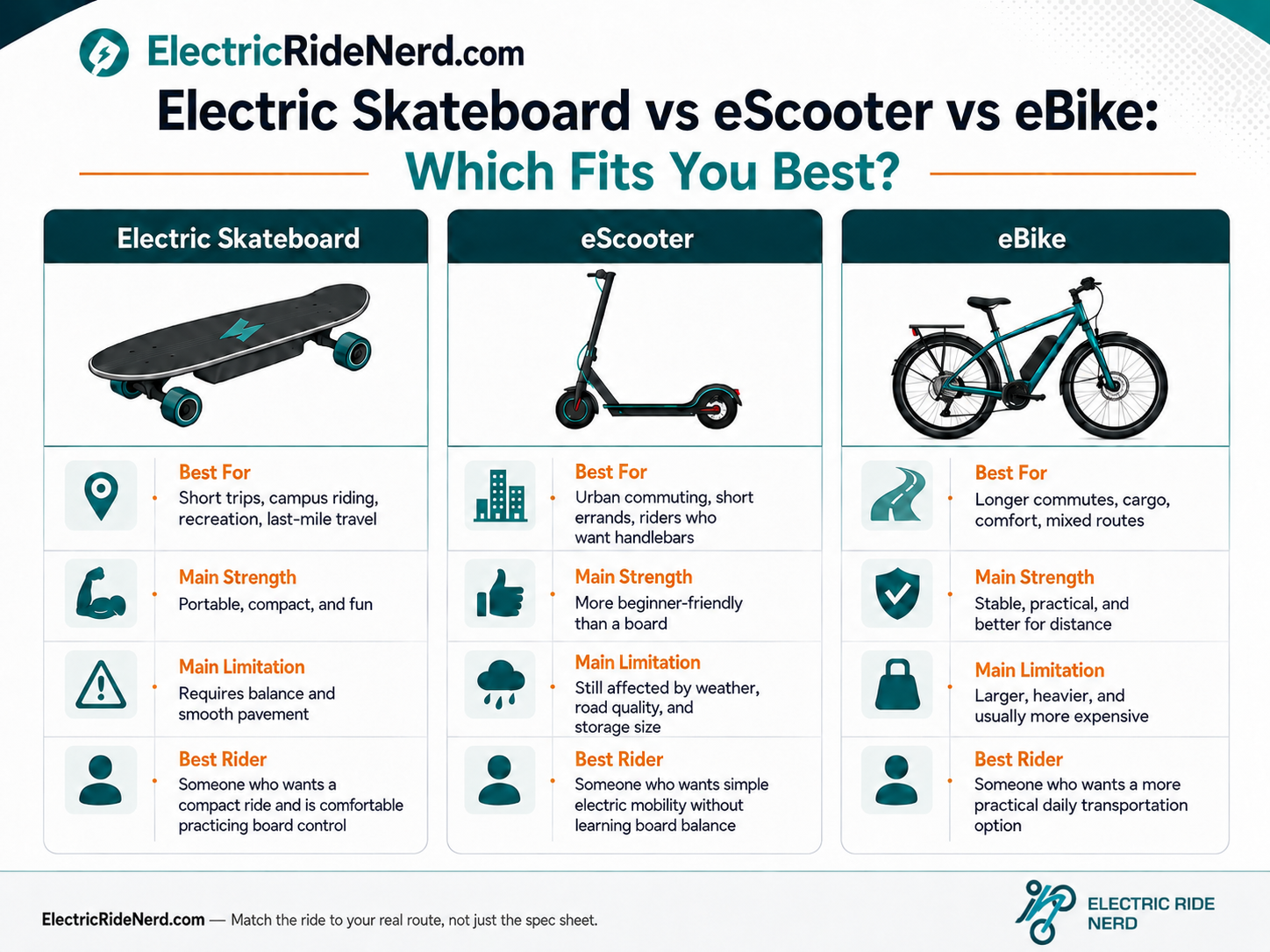
The table below gives a quick side-by-side look at how an electric skateboard, eScooter, and eBike compare for common beginner needs.
| Ride Type | Best For | Main Strength | Main Limitation |
|---|---|---|---|
| Electric Skateboard | Short trips, campus riding, recreation, last-mile travel | Portable, fun, compact | Requires balance and good pavement |
| eScooter | Urban commuting, short errands, riders who want handlebars | More beginner-friendly than a board | Still limited by weather, road quality, and storage size |
| eBike | Longer commutes, cargo, comfort, mixed routes | Stable, practical, better for distance | More expensive, larger, harder to store |
For pure portability, the electric skateboard wins. For beginner confidence, the eScooter may be easier because it gives the rider handlebars and a more upright stance. For daily transportation, longer routes, cargo, and comfort, the eBike is usually the most practical choice.
This is where matching the ride to your real route matters. A board may be perfect for a short campus ride, while an eScooter may feel better for a simple city commute, and an eBike may be the smarter choice for longer daily use.
Use the visual guide below as a quick decision aid before choosing your ride. The best option is not always the fastest or the most exciting one. It is the one that fits your pavement, distance, storage space, comfort level, and daily routine.
Safety Tips Before Riding an Electric Skateboard
Electric skateboards can be enjoyable, but beginners should take safety seriously from the first ride. The motor may make the board feel easy at first, but stopping, turning, and reacting to unexpected hazards takes practice.
Wear Protective Gear
At minimum, wear a properly fitted helmet. Wrist guards, knee pads, elbow pads, gloves, and reflective clothing are also worth considering, especially while learning. Falls on an electric skateboard often happen quickly, and beginners may instinctively put their hands out to catch themselves.
Practice Braking Before Riding in Public
Do not make your first real ride a busy commute. Practice in a quiet, open, paved area. Learn how the remote feels, how the brakes respond, and how the board behaves at low speed before riding near traffic or pedestrians.
Start in the Lowest Speed Mode
Many electric skateboards have multiple speed modes. Beginners should start slow and increase speed gradually. The goal is not to prove how fast the board can go. The goal is to stay in control.
Check the Route Before You Rely on It
A route that looks short on a map may not be safe on a board. Look for hills, rough pavement, construction zones, heavy traffic, narrow shoulders, busy sidewalks, or areas where riding is not allowed.
Federal micromobility safety guidance also reminds riders to stay visible, expect that drivers and pedestrians may not see them, and watch for obstacles or uneven surfaces that can cause sudden stops.
Use the Correct Charger and Charge Safely
Electric skateboards use lithium-ion batteries, so charging habits matter. Use the charger recommended by the manufacturer, avoid damaged batteries or cords, do not modify the battery, and avoid charging while asleep or away from home.
If a battery smells strange, becomes unusually hot, swells, leaks, smokes, or behaves abnormally, stop using it and follow the manufacturer’s safety instructions.
What to Look for Before Buying an Electric Skateboard
Before buying an electric skateboard, think about your actual use case. A board that looks exciting online may not be the best fit for your route, skill level, or storage needs.
For most beginners, the most important buying factors are range, braking control, wheel size, board weight, deck comfort, water-resistance rating, customer support, replacement parts, and battery safety information. A cheaper board may be tempting, but poor brakes, weak electronics, or limited support can make ownership frustrating.
Beginner Buying Tip: Do not buy only for top speed. A smooth remote, predictable braking, good wheels, reliable battery information, and replacement part availability matter more for most riders.
Look for Electrical Safety Information
One buyer-friendly detail to check is whether the manufacturer provides clear electrical safety information. UL 2272 is a safety standard for personal e-mobility electrical systems, including products such as e-skateboards. It is important to understand what that means: electrical safety testing can help address battery, charger, and electrical-system hazards, but it does not prove that a rider can safely control the board.
That distinction matters. A safer electrical system is valuable, but it does not replace wearing protective gear, practicing braking, choosing a safe route, and riding within your skill level.
Federal safety attention around micromobility batteries is also increasing. The CPSC has published a proposed federal micromobility battery safety rule addressing lithium-ion battery risks in micromobility products and their electrical systems, including risks from fires, overheating, smoke inhalation, and thermal runaway.
Who Should Consider an Electric Skateboard?
An electric skateboard may be a good fit if you already enjoy board sports, have decent balance, ride mostly on smooth pavement, and need a compact electric ride for short trips. It can also make sense if you live near a campus, transit stop, office, or neighborhood route where riding is legal and practical.
It may not be a good fit if you need to carry cargo, ride in frequent rain, travel long distances, ride on rough roads, or want maximum stability. In those cases, an eBike or eScooter may be a better choice.
Final Verdict: Is an Electric Skateboard Worth It?
An electric skateboard is worth it for the right rider. It is portable, fun, quiet, and useful for short trips. It can make local travel easier and give you another way to move around without using a car for every small journey.
But it is not a magic commuting solution. It requires balance, safety gear, dry and predictable routes, careful battery habits, and a clear understanding of local laws. Beginners should not buy one only because it looks exciting. They should buy one because it matches their route, skill level, and daily needs.
If you want the most compact electric ride and you are willing to practice, an electric skateboard can be a great choice. If you want comfort, cargo space, and easier beginner stability, you may be happier with an eBike or eScooter.
Frequently Asked Questions About Electric Skateboards
Are electric skateboards good for beginners?
Electric skateboards can work for beginners, but they are not the easiest electric ride to learn. A beginner should start with a slower speed mode, practice in an open paved area, wear protective gear, and avoid traffic until braking and turning feel natural.
How far can an electric skateboard go on one charge?
Many electric skateboards advertise ranges somewhere around 10 to 25 miles, but real-world range depends on rider weight, hills, speed, wind, temperature, pavement, battery size, and riding style. For commuting, choose a board with more range than your exact round trip requires.
Can you ride an electric skateboard in the rain?
Most riders should avoid riding an electric skateboard in the rain. Wet pavement reduces traction and braking control, and water can damage electrical parts if the board is not properly protected. Even water-resistant boards should not be treated like all-weather vehicles.
Are electric skateboards legal on roads or sidewalks?
Electric skateboard laws vary by location. Some areas allow them under certain conditions, while others restrict them on roads, sidewalks, trails, campuses, or public paths. Check your local city, state, province, campus, or park rules before riding in public.
Is an electric skateboard better than an eScooter?
An electric skateboard is usually more compact and fun-focused, while an eScooter is often easier for beginners because it has handlebars and a more upright riding position. The better choice depends on your balance, route, storage needs, and comfort level.
What should beginners look for in an electric skateboard?
Beginners should look for smooth braking, stable handling, beginner speed modes, realistic range, replacement part availability, clear battery safety information, and good customer support. Top speed should not be the first priority.